AI estimate as of July 24, 2025 · verify with a professional before acting
AI-Generated · Verify before acting
Everything on this page is generated by AI for informational purposes only. AI can make mistakes — the AI may misidentify items or misattribute them (artist, maker, brand, designer, origin, era). This is not an official valuation and should not be used for insurance, sale, tax, estate, legal, or lending purposes — or any decision requiring a certified appraisal. It is not an authoritative claim about any person, brand, or rights holder — do not share or rely on it as a factual statement about a third party. Always consult qualified professionals before making financial decisions.
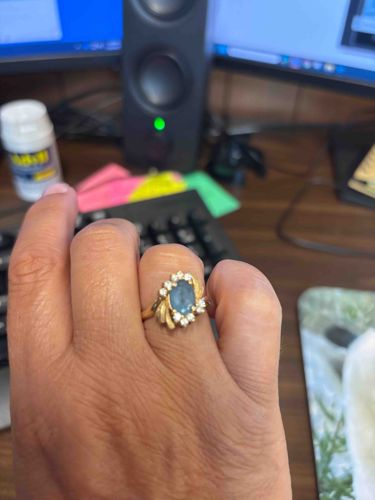
The item is a gold-toned ring featuring an oval-cut, pale blue gemstone as its central element, likely a topaz or aquamarine given its color and common use in jewelry. The central stone is surrounded by a halo of smaller, round, clear gemstones, which appear to be diamonds or diamond simulants based on their sparkle and setting. The setting of the smaller stones is somewhat irregular, creating a playful, sunburst or petal-like effect rather than a perfectly symmetrical halo, with some stones appearing slightly raised or more prominent. The ring's band is a warm yellow metal, consistent with gold. On either side of the central cluster, the gold setting features sculpted, flowing elements, almost like folded ribbons or stylized leaves, adding to the decorative appeal. The overall design suggests a vintage or classic aesthetic, possibly from the mid-to-late 20th century. The ring exhibits good craftsmanship in its setting, though some minor wear might be present on the metal given its apparent age, consistent with an item that has been worn. The stones appear intact and without significant chips or scratches visible in the image. The ring size cannot be determined from the image, but it is worn on the ring finger of a person.
AI Appraisal Report
Upon visual examination of the provided image, I assess this gold-toned ring to be a charming piece of jewelry, likely dating from the mid-to-late 20th century, consistent with its vintage aesthetic. The central oval-cut pale blue gemstone, possibly topaz or aquamarine, is well-set and appears free from significant chips or scratches. The surrounding halo of smaller, clear gemstones are likely diamonds or high-quality diamond simulants, exhibiting good sparkle. The irregular, almost sunburst setting of these smaller stones adds a unique, playful character to the design. The warm yellow metal band, consistent with gold, shows sculpted, flowing elements on the shoulders, indicating good craftsmanship.
Authenticity of the materials, especially the central stone and the halo stones, cannot be definitively confirmed from an image alone. Without physical inspection, I cannot verify if the blue gemstone is natural topaz/aquamarine or a synthetic/treated material, nor can I confirm the identity (natural diamond vs. simulant) or quality (cut, color, clarity) of the halo stones. The metal content (karatage of gold) is also un verifiable.
Given the apparent condition, design, and presumed materials (assuming natural stones and gold), the ring reflects a classic style with enduring appeal. The market for vintage jewelry is generally stable, with demand for pieces featuring genuine gemstones and precious metals remaining consistent. The unique halo setting and sculpted shoulders add to its aesthetic value, setting it apart from more mass-produced items.
Factors impacting value include the actual identity and quality of all gemstones, the gold karatage, and the overall weight. Should the stones prove to be natural diamonds and a genuine aquamarine/topaz, and the metal high-karat gold, the value would be at the higher end or exceed the estimated range. Conversely, if stones are simulants or the metal is gold-plated base metal, the value would be significantly lower.
For full authentication and a precise valuation, an in-person examination by a gemologist is crucial. This would involve testing the gemstones for identity and quality characteristics, assessing the metal composition, and evaluating the exact weight and craftsmanship under magnification. Provenance documentation, if available, would further enhance authentication.