AI estimate as of September 5, 2025 · verify with a professional before acting
AI-Generated · Verify before acting
Everything on this page is generated by AI for informational purposes only. AI can make mistakes — the AI may misidentify items or misattribute them (artist, maker, brand, designer, origin, era). This is not an official valuation and should not be used for insurance, sale, tax, estate, legal, or lending purposes — or any decision requiring a certified appraisal. It is not an authoritative claim about any person, brand, or rights holder — do not share or rely on it as a factual statement about a third party. Always consult qualified professionals before making financial decisions.
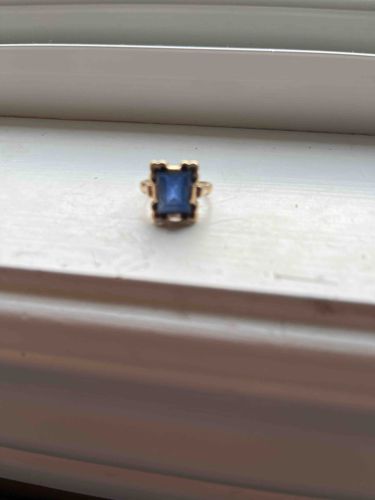
This item is a ring featuring a prominent, rectangular cut, deep blue gemstone set in a yellow or rose gold-toned metal band. The central stone appears to be an emerald cut or similar rectangular facet, exhibiting a saturated blue hue, possibly a sapphire or a synthetic spinel/glass imitation. The stone is horizontally oriented on the finger. The setting is notable for its Art Deco influences, characterized by geometric, angular elements surrounding the stone. Specifically, the bezel or prongs holding the stone feature distinct corner details that extend outwards, forming stylized, somewhat notched or stepped structures at each corner, adding to the architectural feel of the piece. The band itself appears relatively simple, tapering towards the shoulders. The metal exhibits a warm, golden luster, though without closer inspection, it's difficult to ascertain if it's solid gold, gold-filled, or plated. There are no visible maker's marks or signatures in the provided image. The overall condition appears good, with no obvious major damage like chips to the stone or significant scratches to the metal, though a light patina consistent with age might be present on the metalwork. The design suggests a style period from the 1920s to 1940s, indicative of the Art Deco or early Retro eras, emphasizing bold lines and central stones. The craftsmanship seems solid, with the stone securely set, indicating a well-made, possibly antique or vintage piece of jewelry.
AI Appraisal Report
Based on my visual examination of the provided image, this Vintage Art Deco Style Single-Stone Ring presents as a charming example of early 20th-century design. The overall condition appears good, with the rectangular-cut blue gemstone securely set and no obvious chips or major scratches. The metal, which exhibits a warm, golden luster, seems to have a gentle patina consistent with its likely age, suggesting it hasn't been heavily polished or restored. The Art Deco influence is evident in the geometric, stepped style of the bezel or prongs at the corners of the stone, which is a hallmark of the period's architectural aesthetic.
Authenticity of the stone and metal is difficult to determine solely from an image. The deep blue hue of the gemstone could indicate a natural sapphire, a synthetic sapphire, a synthetic spinel, or even glass. Without gemological testing, I cannot definitively identify its composition. Similarly, the warm metal tone suggests yellow or rose gold, but whether it is solid, gold-filled, or plated cannot be verified without physical inspection and density testing. The absence of visible maker's marks is common for vintage pieces but also limits provenance.
Market conditions for Art Deco style rings remain robust, especially for pieces with distinctive design elements. This ring's appeal lies in its strong geometric presence and the striking contrast of the blue stone against the golden metal. Demand for vintage pieces is steady, driven by collectors and those seeking unique, historically rich jewelry. Its rarity depends heavily on the true nature of the materials; if the stone is a natural sapphire and the metal is solid gold, its rarity and value would increase significantly.
Factors significantly impacting value include the type and quality of the gemstone (natural vs. synthetic/imitation), the purity and type of metal (solid gold vs. plated), and the overall craftsmanship. Without physical examination, authenticity verification is inherently limited. For full authentication, I would require in-person inspection to perform gemological tests (e.g., refractive index, specific gravity) on the stone, metal purity tests (e.g., XRF analysis), and a thorough examination for hallmarks and construction details.