AI estimate as of July 4, 2025 · verify with a professional before acting
AI-Generated · Verify before acting
Everything on this page is generated by AI for informational purposes only. AI can make mistakes — the AI may misidentify items or misattribute them (artist, maker, brand, designer, origin, era). This is not an official valuation and should not be used for insurance, sale, tax, estate, legal, or lending purposes — or any decision requiring a certified appraisal. It is not an authoritative claim about any person, brand, or rights holder — do not share or rely on it as a factual statement about a third party. Always consult qualified professionals before making financial decisions.
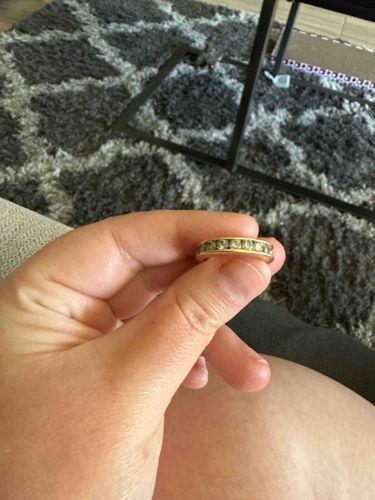
The item is a gold-toned band ring, likely an eternity or anniversary band, featuring a continuous row of bezel-set, round-cut stones. The visible part of the band shows approximately 10 to 12 stones, which appear to be light yellow or greenish-yellow in color, suggestive of treated diamonds, yellow sapphires, or perhaps cubic zirconia, though their exact nature cannot be determined from the image alone. The setting appears to be a full bezel or half-bezel style, encasing the girdle of each stone and providing a smooth, continuous surface along the top of the band. The metal exhibits a rich, polished gold hue. No visible maker's marks, hallmarks, or other inscriptions are discernible in the image. The ring appears to be in good condition with no obvious signs of significant damage like chips or cracks in the stones, or deep scratches/dents on the metal. There might be some minor surface wear consistent with regular use, but detailed assessment is not possible. The overall craftsmanship appears solid, with stones evenly spaced and securely set. Given the style, it likely dates from the late 20th century to the present day, consistent with classic jewelry designs that remain popular.
AI Appraisal Report
Upon my virtual examination of the provided image, I assess this gold-toned eternity band ring to be in good overall condition. There are no readily apparent chips or cracks in the stones, nor significant dents or deep scratches on the metal. The bezel setting appears secure and well-executed, ensuring the continuity of the design. The craftsmanship seems solid, with evenly spaced stones.
Authenticity of the materials, however, is a significant limitation based solely on an image. While the stones present as light yellow or greenish-yellow, their exact nature—whether treated diamonds, yellow sapphires, moissanite, cubic zirconia, or another simulant—cannot be definitively determined without in-person inspection and scientific testing (e.g., refractive index, specific gravity, hardness tests, and spectrographic analysis). Similarly, the “gold-toned” metal could be solid gold, gold-filled, gold-plated base metal, or another gold-colored alloy. Hallmarks, if present, would provide crucial information about metal purity, but none are discernible here. Visual authentication from an image is inherently limited to external appearance.
In terms of market conditions, eternity bands are perennially popular, maintaining consistent demand. Their value is heavily influenced by the preciousness of their materials. Without knowing if the stones are genuine gemstones and the metal is solid gold, comparable items range widely. Genuine diamond or sapphire eternity bands in 14k or 18k gold command substantial prices, while those with simulants and plated metals are significantly less. Rarity is not a factor for this common design.
To provide a full and accurate appraisal, I would absolutely require a hands-on examination to verify the metal purity and stone identity. This would involve specific gravity tests, professional gemological tools, and potentially an XRF scan for the metal. Provenance documentation, if available, could also greatly assist in confirming authenticity and origin.
Based on the visual information only, and assuming the least expensive materials consistent with the appearance (i.e., gold-plated metal and cubic zirconia or glass stones), the value would be at the lower end. If, upon physical inspection, the materials proved to be higher quality (e.g., 14k gold and yellow sapphires), the value would increase significantly.