AI estimate as of September 5, 2025 · verify with a professional before acting
AI-Generated · Verify before acting
Everything on this page is generated by AI for informational purposes only. AI can make mistakes — the AI may misidentify items or misattribute them (artist, maker, brand, designer, origin, era). This is not an official valuation and should not be used for insurance, sale, tax, estate, legal, or lending purposes — or any decision requiring a certified appraisal. It is not an authoritative claim about any person, brand, or rights holder — do not share or rely on it as a factual statement about a third party. Always consult qualified professionals before making financial decisions.
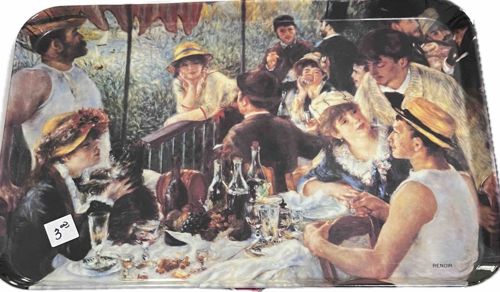
This is a rectangular metal serving or decorative tray featuring a vibrant reproduction of Pierre-Auguste Renoir's famous Impressionist painting, 'Luncheon of the Boating Party' (1881). The tray has rounded corners and a slightly raised rim, typical of standard serving trays, designed to contain spills and make handling easier. The primary colors on the tray reflect those of the original painting, dominated by various shades of green, brown, blue, and flesh tones, capturing the outdoor setting and varied attire of the figures. Details of figures, food, bottles, and the overall lively atmosphere are clearly visible, albeit in a printed format. Below the lower right corner of the printed image, the name 'RENOIR' is subtly visible in white text, identifying the artist. There is a white sticker with the number '3^oo' written on it in black marker, placed on the lower left of the tray's surface, which likely indicates a price or inventory mark. While the overall condition appears good from the image, typical wear for such an item might include minor scratches, dings, or fading, though none are significantly evident here. The surface appears to have a slight sheen, suggesting a protective coating or inherent finish of the material. This item is likely a mass-produced consumer good, intended for decorative or practical use in a home setting, rather than a fine art piece itself. Its age is likely post-1900, probably mid to late 20th century or early 21st century, given the common practice of reproducing famous artworks on household items. The craftsmanship is that of a commercially printed metal tray. The quality is functional, serving its purpose as a decorative and useful household item.
AI Appraisal Report
Based on my visual examination of the provided image, this Renoir ‘Luncheon of the Boating Party’ decorative metal tray appears to be in good overall condition. There are no readily apparent significant scratches, dents, or fading that would drastically diminish its aesthetic appeal or functionality as a decorative or serving item. The clarity of the printed image of the Renoir painting is good, and the presence of the 'RENOIR' signature is typical for such reproductions.
From a market perspective, items like this are mass-produced consumer goods, not fine art. Authenticity as a Renoir artwork is not applicable here, as it's a reproduction. Its authenticity lies as a commercially produced decorative tray. Demand for such items is generally steady but not high, primarily from individuals seeking decorative pieces for their homes or casual collectors of art-themed homeware. Rarity is low; similar trays replicating famous artworks are common and readily available from various eras. Factors impacting its value negatively include its mass-produced nature, lack of material intrinsic value, and the absence of any historical significance or unique craftsmanship. The '3^oo' sticker is likely a previous casual pricing or inventory mark, not indicative of collectible value.
My valuation is based on its utility and decorative appeal as a functional household item. Limitations in assessing condition from images alone include inability to detect minor surface abrasions, subtle color fading, or the exact material quality and thickness of the metal. For a full authentication of the material composition or manufacturing process, physical inspection and potentially material analysis would be required, though these are beyond the scope and necessity for an item of this type and value.