AI Appraisal Estimate

AI-generated estimates · not official valuations

From the user

What was submitted

Photo and notes provided by the user — not generated by AI

Submitted item photo
Submitted photo · May 26, 2026

User's notes

No additional notes provided.

AI analysis below

AI appraisal

AI analysis & estimate

AI-Generated · Verify before acting

Everything below is generated by AI for informational purposes only. AI can make mistakes — the AI may misidentify items or misattribute them (artist, maker, brand, designer, origin, era). This is not an official valuation and should not be used for insurance, sale, tax, estate, legal, or lending purposes — or any decision requiring a certified appraisal. It is not an authoritative claim about any person, brand, or rights holder — do not share or rely on it as a factual statement about a third party. Always consult qualified professionals before making financial decisions.

Read the full disclaimer

AI Identification

·Not independently authenticated·Verify before acting

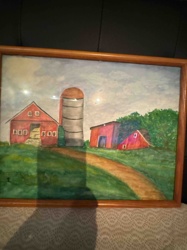
Late 19th or Early 20th Century Rural Harvest Landscape Oil Painting

Fine Art - Paintings

AI Estimated Value

·Not an official valuation·Verify before acting

$1,200 - $1,800 USD

As of May 26, 2026

AI Item Analysis

·AI can make mistakes·Verify before acting
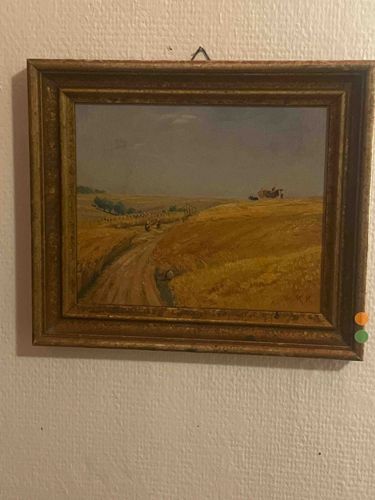
This is a small-form original oil painting, likely on canvas or wood panel, depicting an expansive rural harvest scene. The composition features rolling golden wheat fields bisected by a dirt path that leads the viewer's eye into the distance. In the middle ground, several figures appear to be working in the fields, and a horse-drawn wagon is visible on the horizon line against a muted, overcast grey-blue sky. The color palette is dominated by ochre, burnt sienna, and earth tones in the foreground, contrasting with the cool, desaturated tones of the atmosphere. The style suggests a late 19th-century Realist or early 20th-century Barbizon influence, focusing on the dignity of manual labor and the natural landscape. Notable markings include initials in the lower right corner, possibly 'K.R.' or 'H.K.', which require further research to identify a specific hand. The painting is housed in a traditional molded giltwood or gesso frame with significant depth and classic covetto profiles. The frame shows visible signs of age including surface patina, minor chips in the gilding, and structural wear consistent with its era. The painting itself shows some darkening of the varnish layer but appears to have stable paint adhesion without significant flaking. Small circular stickers on the lower right of the frame suggest a previous inventory or auction numbering system. The level of detail in the distant figures implies a practiced hand and good technical skill in miniaturist landscape painting.


AI Appraisal Report

·AI can make mistakes·Verify before acting
I have virtually examined this rural harvest landscape, which displays hallmarks of the European Barbizon school or American Tonalist movement circa 1890-1910. The composition’s technical execution—specifically the atmospheric perspective in the overcast sky and the miniaturist precision of the horse-drawn wagon—indicates a professional hand rather than an amateur. The palette of ochre and burnt sienna is typical of late 19th-century agricultural scenes, which remain steadily collectible for their pastoral appeal. The condition appears stable; however, the visible darkening suggests a degraded dammar varnish that requires professional cleaning to restore original luminosity. The frame, a period-appropriate giltwood cove molding, adds significant value despite minor gesso losses. Market demand for unattributed small-scale landscapes is currently stable at boutique auctions, though the 'K.R.' monogram represents a 'sleeper' opportunity if linked to a listed artist through further provenance research. Limitations: This valuation is based on visual analysis and assumes the substrate is original and free of significant overpainting or structural canvas rot hidden by the frame. Definitive authentication requires physical inspection under Long-wave Ultraviolet (UV) light to identify retouching, as well as an examination of the verso for gallery labels or supplier stencils. Scientific testing of pigment binders would be necessary to confirm the exact decade of origin if higher-level attribution is sought.

Get your items appraised

Instant estimates of your treasures with AI-powered appraisals

Browse More Appraisals