AI estimate as of August 26, 2025 · verify with a professional before acting
AI-Generated · Verify before acting
Everything on this page is generated by AI for informational purposes only. AI can make mistakes — the AI may misidentify items or misattribute them (artist, maker, brand, designer, origin, era). This is not an official valuation and should not be used for insurance, sale, tax, estate, legal, or lending purposes — or any decision requiring a certified appraisal. It is not an authoritative claim about any person, brand, or rights holder — do not share or rely on it as a factual statement about a third party. Always consult qualified professionals before making financial decisions.
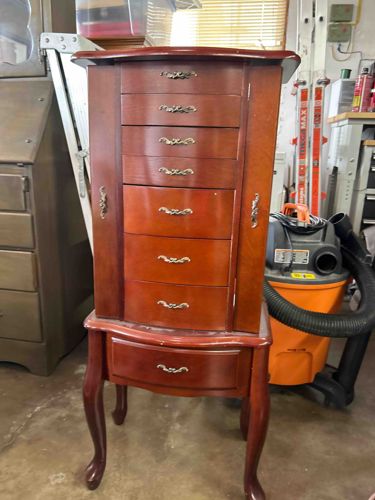
This is a tall, free-standing jewelry armoire, crafted from what appears to be a medium to dark reddish-brown wood, possibly cherry or mahogany-stained wood, with a polished, glossy finish. The main cabinet body is rectangular with a slightly curved or bowed front. It features a stack of five smaller, equally sized drawers at the top, followed by two larger, wider drawers below them, and one even wider drawer forming the bottom of the main cabinet structure. Each of these eight drawers is fitted with two decorative, Baroque-inspired brass-colored pulls, featuring a scrolling, ornate design. The pulls show some signs of age or minor discoloration. On either side of the main drawer stack, there are hinged side doors, each with a single, elongated, matching decorative brass-colored pull, suggesting interior storage for hanging necklaces or chains. The entire cabinet sits atop a separate, elegant stand featuring four cabriole legs that curve outwards and terminate in scrolled feet, characteristic of Queen Anne or Rococo Revival styles. This stand also incorporates a single, wide, shallow drawer with two matching brass-colored pulls, positioned just below the main cabinet. The top surface of the armoire is contoured to match the slight curve of the front. Visible condition issues include scuffing or loss of finish along the top edge of the base where the main cabinet rests, and some minor general wear consistent with use. Despite these minor imperfections, the overall construction appears solid with good craftsmanship, indicated by the smooth finish and the elaborate detailing of the hardware and legs. The style suggests it likely dates from the late 20th or early 21st century, embodying a classic, decorative aesthetic designed for storing a significant collection of jewelry.
AI Appraisal Report
This tall wooden jewelry armoire, likely crafted from cherry or mahogany-stained wood, presents a classic and functional design. Upon visual examination, the overall construction appears solid with good craftsmanship, evidenced by the smooth finish and elaborate detailing of the hardware and cabriole legs. The slightly bowed front, stack of varied drawers, hinged side doors, and ornate brass-colored pulls contribute to its aesthetic appeal, characteristic of Queen Anne or Rococo Revival influences. Condition-wise, I note scuffing or finish loss along the top edge of the base and some minor general wear, consistent with regular use. The decorative pulls show minor signs of age or discoloration, but these imperfections are superficial and do not detract significantly from the piece's utility or charm.
From the image alone, authenticity cannot be definitively ascertained; however, the style strongly suggests a production period from the late 20th to early 21st century. This is not a rare antique but rather a well-made contemporary piece designed to emulate classic furniture. The demand for such functional and decorative furniture remains moderate. Comparables in the secondary market typically range for similar, well-maintained jewelry armoires. The detailed hardware and cabriole legs enhance its marketability. For full authentication regarding wood type, exact age, or manufacturer, an in-person examination, including potential inspection of joinery and material analysis, would be necessary. Provenance documentation would also aid in establishing a more precise history. Without a physical inspection, I cannot confirm structural integrity beyond visible signs, nor can I verify any internal compartments or linings which could impact value.