AI Appraisal Estimate

AI-generated estimates · not official valuations

From the user

What was submitted

Photo and notes provided by the user — not generated by AI

Submitted item photo
Submitted photo · June 26, 2026

User's notes

No additional notes provided.

AI analysis below

AI appraisal

AI analysis & estimate

AI-Generated · Verify before acting

Everything below is generated by AI for informational purposes only. AI can make mistakes — the AI may misidentify items or misattribute them (artist, maker, brand, designer, origin, era). This is not an official valuation and should not be used for insurance, sale, tax, estate, legal, or lending purposes — or any decision requiring a certified appraisal. It is not an authoritative claim about any person, brand, or rights holder — do not share or rely on it as a factual statement about a third party. Always consult qualified professionals before making financial decisions.

Read the full disclaimer

AI Identification

·Not independently authenticated·Verify before acting

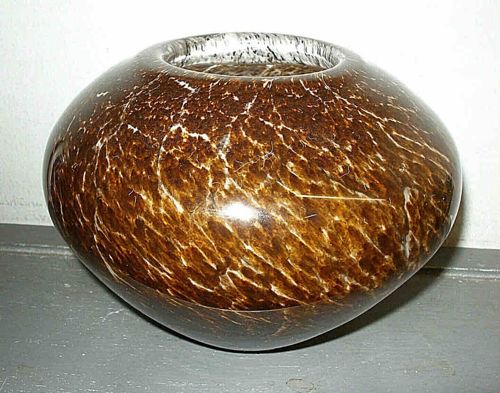
Tortoiseshell Pattern Cased Art Glass Squat Bud Vase

Art Glass / Decorative Objects

AI Estimated Value

·Not an official valuation·Verify before acting

$125 - $225

As of June 26, 2026

AI Item Analysis

·AI can make mistakes·Verify before acting
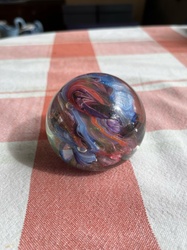
This is a hand-blown art glass vase featuring a distinctive globular or 'squat' form with a relatively narrow, unrimmed aperture. The vessel is constructed using a cased glass technique, appearing to have a clear outer layer over a rich, mottled brown and amber internal decoration that mimics the organic patterns of natural tortoiseshell. This 'tortoise' effect is achieved through the use of glass powders or frits that have been stretched and swirled during the blowing process, creating a sense of depth and movement within the glass. The exterior surface is highly polished to a glossy finish, reflecting light and highlighting the translucent amber tones. The rim appears to be ground and polished flat rather than fire-rolled, which is typical of mid-20th-century studio glass or European glassworks like those in Murano, Italy, or Scandinavia. Condition-wise, the piece appears to be in excellent vintage condition with no visible chips or cracks. There is a faint horizontal linear mark on the right side which may be a surface scratch or a tool mark from production. The lack of visible branding or signatures suggests it may have originally carried a paper label or was produced by a high-quality glasshouse like Sklo Union, Mdina, or Murano makers such as Seguso. It likely dates from the 1960s to 1980s, showcasing the high-quality craftsmanship of the period through its uniform thickness and sophisticated color layering.
AI Appraisal Report

·AI can make mistakes·Verify before acting
I have virtually examined this hand-blown cased glass squat bud vase, which exhibits a sophisticated tortoise pattern. The vessel’s aesthetics—characterized by its globular form and polished, unrimmed aperture—strongly suggest a mid-to-late 20th-century origin. Based on the quality of color dispersion and casing, this likely originates from a reputable studio or glasshouse such as Mdina (Malta), Sklo Union (Czech), or a Murano-based manufacturer like Seguso. The condition appears to be excellent, though a horizontal linear mark on the body requires further inspection to determine if it is a superficial scratch or a tool mark from the blowing process. The market for mid-century art glass remains steady, specifically for pieces mimicking organic materials like tortoiseshell. Comparables for unsigned 1960s-80s European glass in this size range typically sell between $100 and $250. The lack of a signature or acid-etched mark slightly lowers the immediate retail value compared to documented 'signed' pieces. A significant limitation of this remote appraisal is the inability to inspect the base for 'wear' or a pontil mark, which would confirm whether the piece was hand-finished or mold-blown. Furthermore, without a physical examination under UV light to check for specific glass chemistry or a historical provenance check (such as original purchase receipts or labels), I cannot definitively attribute it to a specific designer like Michael Harris. Full authentication would require a tactile inspection to evaluate weight, consistency of the glass batch, and micro-wear on the base, which assists in confirming the item’s age and origin.

Get your items appraised

Instant estimates of your treasures with AI-powered appraisals

Browse More Appraisals