AI estimate as of July 10, 2025 · verify with a professional before acting
AI-Generated · Verify before acting
Everything on this page is generated by AI for informational purposes only. AI can make mistakes — the AI may misidentify items or misattribute them (artist, maker, brand, designer, origin, era). This is not an official valuation and should not be used for insurance, sale, tax, estate, legal, or lending purposes — or any decision requiring a certified appraisal. It is not an authoritative claim about any person, brand, or rights holder — do not share or rely on it as a factual statement about a third party. Always consult qualified professionals before making financial decisions.
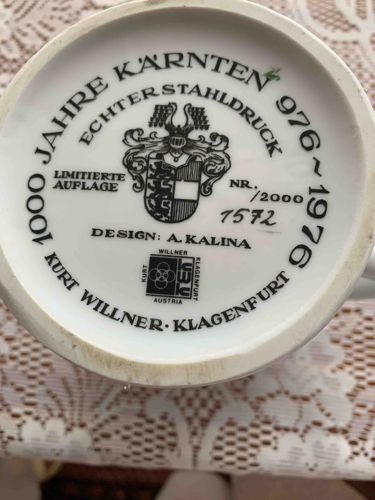
This item is the bottom of a white ceramic or porcelain mug, featuring a detailed black transfer print. The primary text on the base celebrates '1000 JAHRE KÄRNTEN' (1000 Years Carinthia) and marks a period from '976-1976', indicating it's a commemorative piece for the millennium of Carinthia, likely a region in Austria. The printing method is identified as 'ECHTER STAHLDRUCK' (genuine steel engraving print), suggesting a high-quality, precise application of the design. A prominent feature is a heraldic crest or coat of arms, rendered in black, centrally placed, which likely represents Carinthia or a related historical entity. Below the crest, it states 'LIMITIERTE AUFLAGE' (Limited Edition) and is individually numbered 'NR. 7572 /2000', signifying that this particular mug is the 7,572nd out of a total edition of 2,000. This numbering is partially obscured but identifiable. The designer is credited as 'DESIGN: A. KALINA'. Further manufacturing details include 'KURT WILLNER KLAGENFURT AUSTRIA', along with a distinct maker's mark that appears to be a stylized 'KW' or 'WELT' logo within a square, consistent with the 'Willner' name. The overall condition of the base appears good, with no obvious chips or cracks visible from this angle, though there might be minor surface scuffs consistent with typical use or storage. The slightly beige tone around the very edge of the base could indicate light soiling or slight wear from resting on surfaces, but does not appear to be significant damage. The craftsmanship seems of high quality, typical for collectible limited edition ceramics.
AI Appraisal Report
Upon examining the provided image of the Limited Edition Kurt Willner "1000 Years Carinthia" Commemorative Mug (Base), I assess its condition as good. No chips or cracks are visible; minor surface scuffs or slight dirt on the rim are consistent with age and typical handling, not significant damage. The transfer print is clear and legible, retaining its detail.
Authenticity appears high. The detailed text, specific jubilee dates (976-1976), "Echter Stahldruck" (genuine steel engraving print) designation, and clear "K. Willner Klagenfurt Austria" mark, along with the distinct 'KW' maker's mark within a square, are consistent with known Kurt Willner limited edition ceramics. The 'Nr. 7572 /2000' numbering, though partially obscured, strongly indicates a legitimate limited edition. The designer credit to A. Kalina further supports authenticity.
Market conditions for commemorative mugs of this nature are generally stable but niche. While Carinthian historical items have a regional market, global demand for this specific jubilee mug is modest. The 'limited edition' aspect adds value, but the numbering 7572 out of 2000 presents a significant discrepancy, suggesting a potential misprint, a different edition type, or a misunderstanding of the numbering (e.g., sequentially numbered items for a larger series). This discrepancy directly impacts rarity and market perception. If it indeed is numbered 7572 of 2000, it's contradictory and could be perceived as a flaw, negatively impacting collector value unless further clarification or context from the manufacturer is available.
For full authentication, in-person examination is crucial to verify the tactile quality of the porcelain/ceramic, the precision of the steel engraving print (to differentiate from standard transfer prints), and to confirm the numbering without visual obstruction. Provenance documentation (e.g., original certificate of authenticity, purchase receipts) would definitively confirm its authenticity and shed light on the numbering discrepancy. Without physical inspection and additional context for the numbering, definitive authentication is limited to visual consistency with known examples.