These notes were written by the person who submitted this item. Appraiser.AI has not verified them, and the AI's identification and estimate may rely on them.
AI Estimated Value
Not an official valuation
$50 - $100
AI estimate as of June 16, 2025 · verify with a professional before acting
AI-Generated · Verify before acting
Everything on this page is generated by AI for informational purposes only. AI can make mistakes — the AI may misidentify items or misattribute them (artist, maker, brand, designer, origin, era). This is not an official valuation and should not be used for insurance, sale, tax, estate, legal, or lending purposes — or any decision requiring a certified appraisal. It is not an authoritative claim about any person, brand, or rights holder — do not share or rely on it as a factual statement about a third party. Always consult qualified professionals before making financial decisions.
This analysis also relies on unverified notes provided by the user, which may be incomplete or inaccurate and could affect the result.
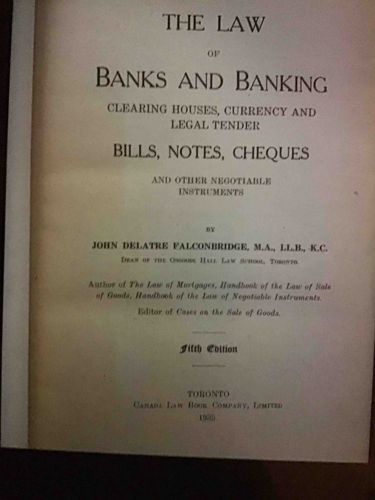
The item is a vintage legal textbook titled "The Law of Banks and Banking". The cover, shown in cream or off-white, displays the title prominently in large, dark lettering at the top, followed by a listing of the topics covered: "Clearing Houses, Currency and Legal Tender", "Bills, Notes, Cheques", and "And Other Negotiable Instruments". Below the title information, the author's name, John Delatre Falconbridge, is listed with his academic and professional titles: M.A., LL.B., K.C., and his role as Dean of the Osgoode Hall Law School in Toronto. Further down, it details his other published works and editorial roles. The edition is stated as the "Fifth Edition". The publisher is the Canada Law Book Company, Limited, located in Toronto, and the publication year is clearly marked as 1935. The printing style and layout are typical of legal texts from the early 20th century, featuring a clear, formal typeface. The overall appearance suggests a well-preserved copy, consistent with the description of being in good condition. There are no significant visible tears, stains, or damage to the cover shown. The binding edge is visible on the left side of the image, appearing intact. The paper shows a slight yellowing due to age, which is a natural patina expected for a book of this era. The craftsmanship appears functional and sturdy for the intended use.
AI Appraisal Report
Based on my remote visual examination of the submitted image, this is a copy of "The Law of Banks and Banking, Fifth Edition" by John Delatre Falconbridge, published in 1935 by The Canada Law Book Company, Limited. The cover appears to be in good overall condition, consistent with the owner's description. There are no immediately visible tears, significant stains, or damage. The binding appears intact. The paper displays the natural yellowing expected of a book from this era, which contributes to its vintage appeal rather than detracting significantly from value, provided it is not brittle. The typography and layout are appropriate for the stated 1935 publication date.
Legal textbooks from this period, while important historically, generally have a limited market value compared to first edition literary works or historically significant documents. The demand is primarily from legal historians, institutions, or collectors specializing in the history of law. Fifth editions are typically less sought after than first editions, though for a specific legal topic like banking, early major treatises can still hold some interest. Market comparables for similar academic or legal texts of this age and condition range modestly.
Factors impacting value include the good stated condition and the specific subject matter, which might appeal to a niche collector. Rarity is moderate; while a 1935 textbook isn't exceedingly rare, copies in good condition become less common over time. Without a physical inspection, I cannot definitively assess the integrity of the binding beyond what is visible, the presence of any internal markings, foxing, or the condition of the page edges. A full physical inspection would be necessary to confirm the condition of the entire text block and verify authenticity beyond doubt through paper type, printing methods, and binding structure. Provenance documentation, such as purchase records, would further enhance authentication, though is less common for such items.