AI estimate as of October 26, 2025 · verify with a professional before acting
AI-Generated · Verify before acting
Everything on this page is generated by AI for informational purposes only. AI can make mistakes — the AI may misidentify items or misattribute them (artist, maker, brand, designer, origin, era). This is not an official valuation and should not be used for insurance, sale, tax, estate, legal, or lending purposes — or any decision requiring a certified appraisal. It is not an authoritative claim about any person, brand, or rights holder — do not share or rely on it as a factual statement about a third party. Always consult qualified professionals before making financial decisions.
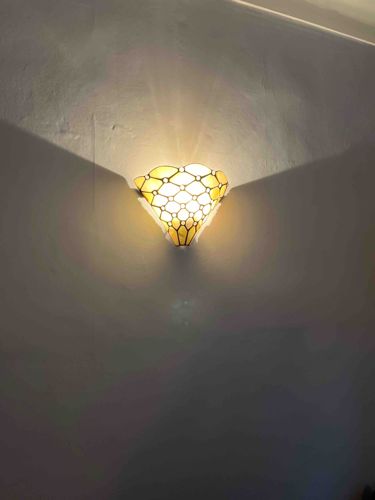
This item is a decorative wall sconce crafted in the Tiffany-style, featuring stained glass panels. The scone has a distinctive fan or shell-like shape, narrowing towards the bottom and flaring out at the top, fitting snugly into a corner or against a flat wall, casting light both upwards and downwards. The stained glass is composed of numerous individual pieces of glass, pieced together with lead or copper foil, creating a complex tessellated pattern. The dominant colors appear to be various shades of cream, amber, and light yellow, which, when illuminated, emit a warm, inviting glow. The intricate pattern visible in the central and upper sections consists of small, interconnected cellular or honeycomb-like shapes, while the outer lower edges feature more elongated, petal-like segments. The construction suggests traditional stained-glass techniques, indicating a handcrafted quality. The metal framework, likely bronze, copper, or a similar dark-toned metal, is visible as the lines separating the glass pieces and forms the support structure. Given the detailed artistry and materials, this piece could be a reproduction or inspired by the Art Nouveau or Arts and Crafts movements, typically ranging from the late 20th century to contemporary manufacturing. No visible damage or repairs are apparent from the image; the condition appears good, with the light shining brightly and evenly through the glass. The illumination creates a soft, diffused light pattern on the adjacent walls, highlighting its function as an ambient or accent light fixture.
AI Appraisal Report
I have examined the provided image of this Tiffany-style stained glass wall sconce. Visually, the sconce appears to be in good condition, showing no obvious signs of damage, cracks, or repairs to the glass or metalwork. The illumination is even, suggesting operational integrity. The design, with its fan or shell-like shape and warm amber, cream, and yellow stained glass, is characteristic of Tiffany-inspired pieces, drawing on Art Nouveau and Arts and Crafts aesthetics.
Authenticity is a significant factor. From the image alone, I can confirm this is a 'Tiffany-style' piece, meaning it emulates the aesthetic of original Tiffany lamps. Full authentication as an antique Tiffany Studios piece would require in-person examination to assess the quality of glass (e.g., opalescence, streaking), soldering techniques, specific pattern replication, and manufacturer marks, which are not discernible here. Provenance documentation, such as original sales receipts or historical records, would be crucial. Scientific testing of materials might also be necessary to definitively date the components.
Market conditions for Tiffany-style reproductions are generally stable, driven by aesthetic appeal as accent lighting. Comparables in this style, particularly contemporary or late 20th-century reproductions, typically retail in the $100-$400 range, depending on complexity and size. This piece's intricate pattern and good apparent condition place it in the mid-to-upper end of this range for a reproduction. Demand for decorative lighting of this style is consistent, but rarity is low for reproductions.
The primary factor impacting value is its status as a reproduction rather than an original Tiffany piece. Were this an authenticated original, the value would be astronomical. As a well-executed Tiffany-style sconce, its value lies in its decorative appeal and functionality. Currently, without further authentication beyond the visual, my appraisal reflects its value as a decorative, functional reproduction.