AI estimate as of November 13, 2025 · verify with a professional before acting
AI-Generated · Verify before acting
Everything on this page is generated by AI for informational purposes only. AI can make mistakes — the AI may misidentify items or misattribute them (artist, maker, brand, designer, origin, era). This is not an official valuation and should not be used for insurance, sale, tax, estate, legal, or lending purposes — or any decision requiring a certified appraisal. It is not an authoritative claim about any person, brand, or rights holder — do not share or rely on it as a factual statement about a third party. Always consult qualified professionals before making financial decisions.
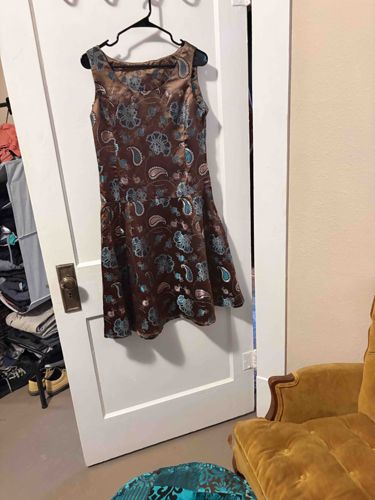
This is a sleeveless dress featuring a rich brown background with an ornate teal and light blue paisley and floral pattern. The fabric appears to be a satin or a similar material with a slight sheen, suggesting it might be polyester or a silk blend. The dress has a scoop neckline and a fitted bodice that transitions into a slight A-line or flared skirt. The pattern covers the entire garment, consisting of various sizes of paisley motifs intertwined with stylized floral elements. Some of the paisley shapes are outlined, adding depth to the design. The color palette of brown with blue and teal undertones gives it a somewhat vintage or autumnal feel. The construction appears to be straightforward, with clean seams visible around the neckline and armholes. There are no visible tags or labels to indicate the manufacturer or specific material composition. The dress is hanging on a black plastic hanger against a white door, which has an old-fashioned brass door handle. The overall condition of the dress seems good, with no obvious tears, stains, or significant wear visible from the image. The fabric drapes well, indicating a decent quality material. The style could be reminiscent of designs from the late 20th century, possibly 1990s or early 2000s, given the paisley trend revival during those periods. The dress appears to be a formal or cocktail attire piece, suitable for various occasions.
AI Appraisal Report
Upon visual examination of the provided image, this Brown and Teal Paisley Sleeveless Dress is in good condition, showing no apparent tears, stains, or significant wear. The fabric exhibits a slight sheen, suggesting polyester or a synthetic blend, but a definitive material identification would require physical inspection. The design, featuring a rich brown background with teal and light blue paisley and floral patterns, points towards a style popular in the late 1990s or early 2000s, consistent with a vintage or autumnal aesthetic. The construction appears straightforward, with clean visible seams. Without any visible labels or tags, authenticity regarding brand or designer cannot be verified through the image alone.
In terms of market conditions, dresses of this style and presumed material typically fall into the affordable vintage or secondhand casual/cocktail wear category. Comparable items from similar eras, especially without a known designer or high-end material, tend to sell in the $30-$80 range. The demand for such a specific paisley pattern is moderate, appealing to those seeking retro or unique prints, but it is not a highly sought-after or rare item. Its value is primarily driven by its good condition and classic, albeit dated, aesthetic rather than inherent rarity or designer pedigree.
Factors significantly impacting value include the unknown fabric composition, which if proven to be silk, would increase its value. Conversely, if it is a low-quality synthetic fabric, the value might be closer to the lower end. The lack of brand identification is also a limiting factor. For full authentication and a more precise valuation, I would require an in-person examination to assess fabric quality, confirm exact material composition, inspect internal construction details, and search for any hidden labels. Documentation of provenance, such as original purchase receipts, would also be beneficial to confirm its history and potential designer association, though unlikely for an item of this type.