AI estimate as of September 8, 2025 · verify with a professional before acting
AI-Generated · Verify before acting
Everything on this page is generated by AI for informational purposes only. AI can make mistakes — the AI may misidentify items or misattribute them (artist, maker, brand, designer, origin, era). This is not an official valuation and should not be used for insurance, sale, tax, estate, legal, or lending purposes — or any decision requiring a certified appraisal. It is not an authoritative claim about any person, brand, or rights holder — do not share or rely on it as a factual statement about a third party. Always consult qualified professionals before making financial decisions.
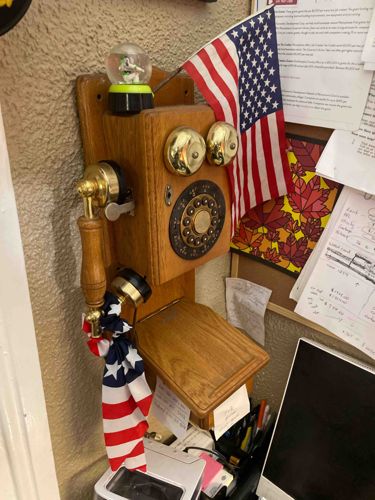
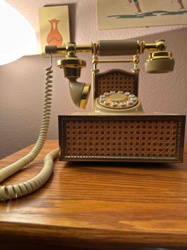
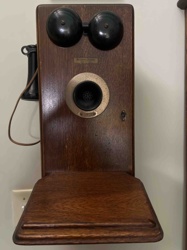
This item is a wall-mounted telephone designed to emulate the appearance of an early 20th-century candlestick or wall-mounted telephone, likely a decorative reproduction rather than an authentic antique. The primary material is stained wood, possibly oak or a similar hardwood, with a clear lacquered finish. The body consists of a rectangular main unit with a rounded top edge, mounted vertically on a wall. Attached to the left side of the main unit is a brass-colored metal hook or cradle, from which a receiver/transmitter unit hangs. This receiver/transmitter unit has a wooden handle in the middle, and brass-colored metal components at both ends, resembling an old-fashioned telephone handset. The main wooden body features a visible circular rotary dial, characteristic of telephones from the mid-20th century, with numbers and letters arranged around the perimeter. There appear to be two prominent, round, brass-colored bells or gongs mounted near the top of the main wooden unit, which suggests it is designed to mimic an older magneto-style telephone. Below the main telephone unit, there is a small, hinged wooden shelf or writing platform, which is currently in an open, horizontal position. The overall construction appears sturdy, and the wood shows a consistent medium-brown stain, typical of 'antique' reproductions. There are no obvious signs of significant damage such as cracks or chips in the wood, though minor superficial scratches or wear from use might be present, consistent with a used decorative item. The brass-colored elements show some natural patina or possibly intentional antiquing to give them an aged look. The craftsmanship appears to be of reasonable quality for a decorative piece, aiming for aesthetic appeal over precise historical accuracy. Given the inclusion of a rotary dial on a wall-mounted style that historically often lacked one, and the overall 'classic' look, this piece likely dates from the late 20th century or early 21st century, manufactured as a novelty or retro-style phone.
AI Appraisal Report
Based on my visual examination of the provided image, this Vintage-Style Wooden Wall-Mounted Rotary Telephone is clearly a decorative reproduction rather than an authentic antique.
**Condition and Authenticity:** The item appears to be in good cosmetic condition with no obvious structural damage such as large cracks or chips in the wood. The metal components show a consistent patina, likely intentional antiquing, typical of reproductions. The combination of a rotary dial with a 'candlestick'/wall-mounted design, and the prominent, unscreened bells, points strongly to its being a modern decorative piece, likely from the late 20th or early 21st century. Authentic antique wall phones of this style generally predate the common use of rotary dials, or had very different internal mechanisms. This is a functional decorative item, not a historical relic. I can't confirm if the rotary dial is actually functional or purely decorative without a hands-on test.
**Market Conditions and Comparables:** The market for such retro-style decorative telephones is relatively stable but not subject to significant appreciation. Similar reproductions, often sold by retailers specializing in vintage decor, range from approximately $70 to $200, depending on the manufacturer, material quality, and features (e.g., actual working phone vs. purely decorative). This item fits squarely within the mid-range of these comparables.
**Demand and Rarity:** Demand is modest, driven by individuals seeking nostalgic or specific aesthetic elements for home decor rather than collectors of genuine antique telecommunications equipment. It is not a rare item; many similar reproductions were produced.
**Factors Impacting Value:** Its value is primarily driven by its decorative appeal and condition. Its status as a reproduction significantly limits its collectible value, which would be far higher for a genuine antique. The assumed functionality (as a working phone) would slightly increase its value over a purely decorative prop.
**Limitations of Verification:** My assessment is based solely on visual cues from the image. I cannot definitively verify its operational status (if it's a working phone or just a prop) without physical testing. Without physical inspection, I cannot confirm the exact type of wood, the quality of internal components (if any), or detect minor surface imperfections like scratches or dings that would impact condition. Provenance (documentation of its origin or history) would typically be irrelevant for a decorative reproduction of this nature.