From the user

What was submitted

Photo and notes provided by the user — not generated by AI

Submitted item photo
Submitted photo · May 15, 2026

User's notes

No additional notes provided.

AI analysis below

AI appraisal

AI analysis & estimate

AI-Generated · Verify before acting

Everything below is generated by AI for informational purposes only. AI can make mistakes — the AI may misidentify items or misattribute them (artist, maker, brand, designer, origin, era). This is not an official valuation and should not be used for insurance, sale, tax, estate, legal, or lending purposes — or any decision requiring a certified appraisal. It is not an authoritative claim about any person, brand, or rights holder — do not share or rely on it as a factual statement about a third party. Always consult qualified professionals before making financial decisions.

Read the full disclaimer

AI Identification

·Not independently authenticated·Verify before acting

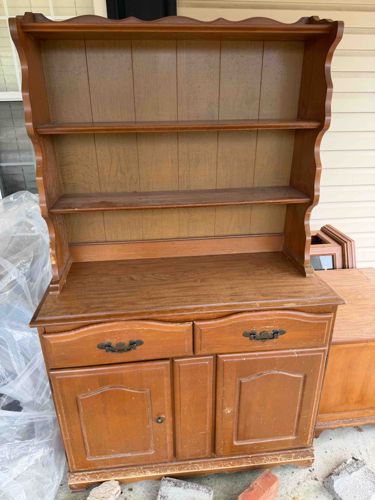
Mid-20th Century Early American Style Highboy Hutch

Furniture / Case Goods

AI Estimated Value

·Not an official valuation·Verify before acting

$75 - $150

As of May 15, 2026

AI Item Analysis

·AI can make mistakes·Verify before acting
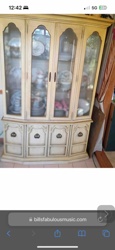
This is a two-piece freestanding hutch or buffet with hutch top, constructed in the Early American / Colonial Revival style popular during the mid-to-late 20th century. The piece is likely constructed from pine or maple solids with wood veneers and a medium honey-oak finish. The upper section features a scrolled or 'scalloped' valance at the top and matching decorative curved side supports. It contains two fixed shelves with plate grooves, set against a 'v-groove' paneled backboard that mimics traditional wide-plank construction. The lower cabinet base consists of two side-by-side drawers with decorative batwing brass-toned bail pulls and raised-panel fronts. Below the drawers are two cabinet doors with arched raised-panel detailing, separated by a central stile. Regarding condition, the piece shows significant signs of wear consistent with age and storage in a garage or outdoor environment. There is visible finish degradation, specifically scuffing and wood loss along the bottom base molding. Multiple white paint-like splatters are present on the right cabinet door and base. Swelling or water damage may be present at the bottom edge. While functionally solid, the item requires a full refinishing to restore its aesthetic value. The craftsmanship suggests mass-production from the 1960s-1970s, typical of brands like Ethan Allen or Tell City, though no visible maker's mark is confirmed in the photo.
AI Appraisal Report

·AI can make mistakes·Verify before acting
Based on my visual inspection, this hutch is a mid-to-late 20th-century Colonial Revival mass-produced piece, common to the 1960s and 70s. While it mimics traditional Early American craftsmanship with its scalloped valance and batwing hardware, the construction and 'v-groove' backing indicate industrial factory manufacturing. The condition is the primary factor limiting its market value. I observed significant finish degradation, white paint splatters on the right door, and notable moisture-related swelling along the base molding. These defects necessitate a full professional refinishing, the cost of which would likely exceed the final market value of the piece. The market for brown, mass-produced Colonial Revival furniture has shifted significantly; currently, such pieces are primarily sought after as 'project pieces' for DIY 'shabby chic' painting. Comparables for items in this condition at regional estate auctions or local marketplaces typically sell within the $75 to $150 range. If restored to its original honey-oak luster, the value could increase, but it lacks the rarity of true 18th-century antiques. Note that this appraisal is based on image analysis alone, which limits my ability to confirm structural integrity, wood species (likely pine or maple), or identify maker marks (e.g., Ethan Allen) hidden inside drawer boxes. A physical inspection is required to check for 'dry rot,' odors from storage, or drawer glide functionality. Full authentication would require verifying the presence of secondary woods and construction joins (machine-cut vs. hand-dovetailed). For a definitive valuation, I would need to examine the back of the carcass and the underside of the drawers to confirm the absence of modern composite materials.

Get your items appraised

Instant estimates of your treasures with AI-powered appraisals

Browse More Appraisals