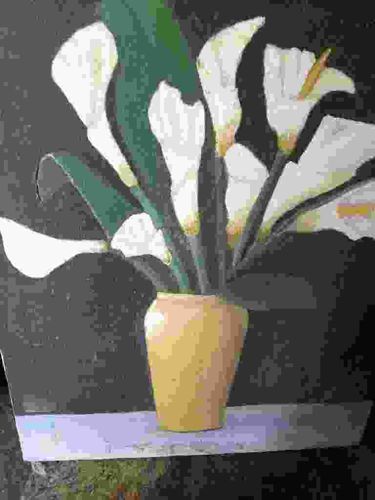
Still Life with Calla Lilies in a Yellow Vase
This is a twentieth-century still life painting executed in a style reminiscent of Art Deco or mid-century modernism. The composition features a bold arrangement of white calla lilies sprouting from a narrow-necked, bulbous yellow ceramic vase. The flowers are characterized by their iconic white spathes and visible yellow spadices, supported by thick, elongated green stems and broad foliage. The background is a stark, flat black, which creates a high-contrast dramatic effect, while the surface underneath the vase is rendered in a light lavender or pale blue tone. Structurally, the work employs a graphic, almost poster-like aesthetic with simplified forms and flat planes of color, suggesting a possible origin from the mid-20th century (circa 1940s–1960s). The brushwork appears deliberate and smooth. No signature is clearly visible in the provided image. The condition shows visible signs of aging; specifically, there is significant craquelure and pixelated distortion across the image surface, which may indicate either photographic degradation or brittle paint film. The edges of the canvas or board show some wear and unevenness, particularly at the bottom left corner where the substrate seems exposed or abraded. The overall craftsmanship suggests a trained hand prioritizing stylized form over realistic detail.
AI-Generated Appraisal Disclaimer
Estimated Value
$400 - $650
Basic Information
Category
Fine Art - Paintings
Appraised On
March 20, 2026
Estimated Value
$400 - $650
Item Description
This is a twentieth-century still life painting executed in a style reminiscent of Art Deco or mid-century modernism. The composition features a bold arrangement of white calla lilies sprouting from a narrow-necked, bulbous yellow ceramic vase. The flowers are characterized by their iconic white spathes and visible yellow spadices, supported by thick, elongated green stems and broad foliage. The background is a stark, flat black, which creates a high-contrast dramatic effect, while the surface underneath the vase is rendered in a light lavender or pale blue tone. Structurally, the work employs a graphic, almost poster-like aesthetic with simplified forms and flat planes of color, suggesting a possible origin from the mid-20th century (circa 1940s–1960s). The brushwork appears deliberate and smooth. No signature is clearly visible in the provided image. The condition shows visible signs of aging; specifically, there is significant craquelure and pixelated distortion across the image surface, which may indicate either photographic degradation or brittle paint film. The edges of the canvas or board show some wear and unevenness, particularly at the bottom left corner where the substrate seems exposed or abraded. The overall craftsmanship suggests a trained hand prioritizing stylized form over realistic detail.
Get Your Items Appraised
Instant estimates of your treasures with AI-powered instant appraisals