AI estimate as of September 14, 2025 · verify with a professional before acting
AI-Generated · Verify before acting
Everything on this page is generated by AI for informational purposes only. AI can make mistakes — the AI may misidentify items or misattribute them (artist, maker, brand, designer, origin, era). This is not an official valuation and should not be used for insurance, sale, tax, estate, legal, or lending purposes — or any decision requiring a certified appraisal. It is not an authoritative claim about any person, brand, or rights holder — do not share or rely on it as a factual statement about a third party. Always consult qualified professionals before making financial decisions.
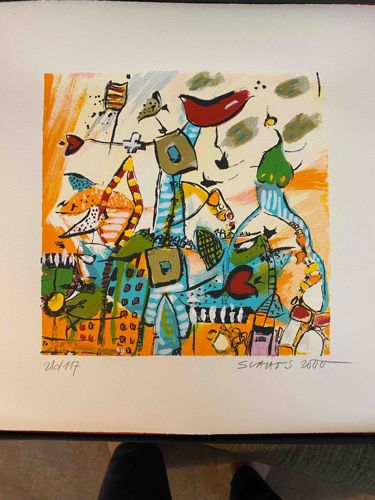
This item is a colorful, abstract serigraph (screenprint) on paper, featuring a lively composition with elements that suggest both figures and fantastical architecture. The print is characterized by a vibrant palette dominated by oranges, blues, greens, and reds, with accents of black and white. The style appears to be a blend of cubist and naive art, with fragmented shapes and whimsical forms. Visible physical characteristics include a rectangular image area, with significant white borders around the artwork itself, indicating it is likely matted for framing or intended for such. The colors are bold and appear well-saturated, suggesting a high-quality printing process. Notable features include what appear to be cartoonish figures or structures, some with striped patterns (blue and white, green and white), others with dotted or irregular textures. A prominent red, wavy shape resembling a bird or abstract cloud is visible in the upper right. Other shapes resemble a weather vane, various pouches, or architectural elements with domed tops. Markings indicate this is a limited edition print, numbered '21/117' on the lower left, signifying it is the 21st print out of an edition of 117. The artist's signature, 'SAMY', followed by the year '2000', is present on the lower right, hand-signed in pencil. The paper itself appears to be heavy stock, off-white in color, and shows no discernible condition issues like tears, creases, foxing, or significant discoloration, which speaks to its good preservation. The craftsmanship is evident in the precise registration of colors typical of serigraphy, and the overall energetic and playful aesthetic suggests a post-modern or contemporary art piece. This print represents a distinctive artistic style, likely appealing to collectors of modern or contemporary graphic art.
AI Appraisal Report
I have examined the provided image of this Abstract Figurative Serigraph by Samy, dated 2000. Based on the visual evidence, the artwork appears to be in excellent condition, with vibrant, well-saturated colors and no visible signs of foxing, creasing, tears, or significant discoloration on the heavy stock paper. This good preservation significantly contributes to its value.
Authenticity, based solely on the image, appears strong. The hand-signed 'SAMY 2000' in pencil on the lower right, coupled with the limited edition numbering '21/117' on the lower left, is consistent with how contemporary serigraphs are typically marked by artists. The precise color registration evident in the image also suggests a professional serigraphy process.
Market conditions for abstract figurative serigraphs by contemporary artists like Samy, particularly those in limited editions, are generally stable. Similar works by lesser-known contemporary artists of this style and period often fall within the hundreds of dollars range. Factors impacting value include the artist's recognition, the specific aesthetic appeal, and the condition. This piece's playful, energetic style and excellent condition enhance its marketability. Rarirty is moderate given it's a limited edition of 117.
Limitations in authenticity verification from images alone are inherent. While the signature and numbering visually accord with typical practices, an in-person examination would allow for closer inspection of the paper's texture, the ink's application, and the graphite of the pencil signature and numbering, which can provide more definitive authentication clues. Additionally, provenance documentation (e.g., certificate of authenticity, sales receipts from reputable galleries) would offer conclusive proof of authenticity, which is not available from the image alone.