AI estimate as of August 7, 2025 · verify with a professional before acting
AI-Generated · Verify before acting
Everything on this page is generated by AI for informational purposes only. AI can make mistakes — the AI may misidentify items or misattribute them (artist, maker, brand, designer, origin, era). This is not an official valuation and should not be used for insurance, sale, tax, estate, legal, or lending purposes — or any decision requiring a certified appraisal. It is not an authoritative claim about any person, brand, or rights holder — do not share or rely on it as a factual statement about a third party. Always consult qualified professionals before making financial decisions.
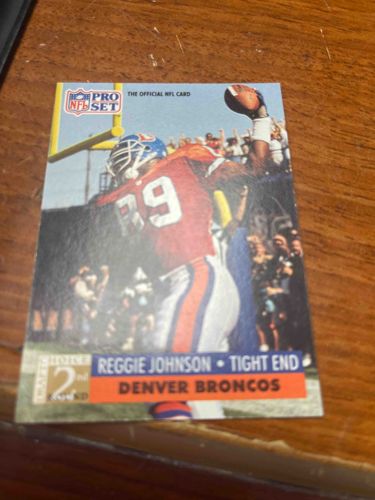
The item is a vintage NFL Pro Set football trading card featuring Reggie Johnson, identified as a Tight End for the Denver Broncos. The card has a standard trading card size, typically around 2.5 x 3.5 inches, and is made of cardstock, characteristic of sports cards from its era. The primary image on the card depicts Reggie Johnson in action during a football game, wearing a Denver Broncos jersey with the number '89' prominently displayed on his back. The background features other players, what appear to be goalposts, and a stadium crowd, suggesting an authentic game photo.
In the upper left corner, the 'NFL PRO SET' logo is clearly visible, along with the text 'THE OFFICIAL NFL CARD', indicating its authenticity and official licensing. At the bottom of the card, an orange banner contains the player's name, position, and team: 'REGGIE JOHNSON • TIGHT END' and 'DENVER BRONCOS'. To the left of this banner, there's a smaller white and gold emblem with the number '12' and 'CHANCE' written vertically, which might indicate a series number, subset, or a chance-based insert within the Pro Set release.
Visually, the card shows signs of typical age and handling, including what appears to be some surface wear or slight creasing visible across the main image area, particularly towards the center and bottom. The coloration seems consistent with original printing, although some slight fading or discoloration might be present due to exposure over time. The edges and corners are not perfectly sharp, suggesting some corner wear or slight edgewear, which is common for cards that have been handled or stored without strict preservation. No specific manufacturing marks or signatures are discernible from the provided image beyond the 'NFL PRO SET' branding. Based on the 'Pro Set' branding and design style, this card likely dates from the late 1980s to early 1990s, a period when Pro Set was a popular manufacturer of NFL trading cards. The craftsmanship appears to be standard for mass-produced trading cards of that era, with good image clarity and color registration.
AI Appraisal Report
I have examined the provided image of the Reggie Johnson 1990-1992 NFL Pro Set Football Card (Denver Broncos #89). My assessment of its condition is based solely on visual inspection. The card exhibits signs of typical age and handling for its era. I observe what appears to be surface wear, minor creasing, and evidence of corner and edge wear. The color registration seems good, but some slight fading cannot be ruled out from an image. The 'NFL PRO SET' branding confirms its official licensing. Authenticity, based on the clearly visible official branding and design consistent with Pro Set cards from the early 1990s, appears strong. However, without in-hand inspection, I cannot verify print quality nuances consistent with genuine pieces or detect potential alterations.
Market conditions for common 1990s Pro Set cards are generally low. Pro Set was massively overproduced during this era, leading to an abundant supply. Reggie Johnson, while a solid player, is not a Hall of Famer or a highly sought-after superstar, which limits demand for his common cards. Rarity is very low due to the high production volume. Factors significantly impacting value are primarily the card's condition (which is not gem mint here) and the common nature of the set and player.
Limitations in authenticity verification from images alone are significant. While the visible official branding is reassuring, a physical examination would be needed to confirm card stock, print quality, and precise cuts. Provenance documentation (e.g., original packaging, purchase receipts) could further strengthen authentication. Scientific testing, such as microscopic analysis of printing dots or paper composition, would offer the highest level of authentication, but is typically reserved for high-value items.