AI estimate as of August 9, 2025 · verify with a professional before acting
AI-Generated · Verify before acting
Everything on this page is generated by AI for informational purposes only. AI can make mistakes — the AI may misidentify items or misattribute them (artist, maker, brand, designer, origin, era). This is not an official valuation and should not be used for insurance, sale, tax, estate, legal, or lending purposes — or any decision requiring a certified appraisal. It is not an authoritative claim about any person, brand, or rights holder — do not share or rely on it as a factual statement about a third party. Always consult qualified professionals before making financial decisions.
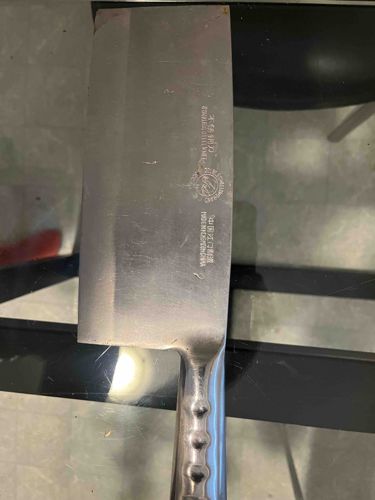
The item is a Chinese cleaver, characterized by its broad, rectangular stainless steel blade with a polished, reflective finish. The overall length appears to be approximately 12 to 14 inches, with the blade itself likely occupying about 7 to 8 inches. The blade is thick at the spine, common for cleavers designed for heavy-duty kitchen tasks like chopping through bone or tough vegetables, and tapers towards the cutting edge, which shows some signs of use. There are visible surface scratches and minor scuffs on the blade's flat surface, indicative of regular use and cleaning, but no major rust or pitting is immediately apparent, suggesting good quality stainless steel. The handle is also made of stainless steel, designed with a contoured, ergonomic shape that features three distinct indentations or finger rests for improved grip and comfort. This type of all-metal construction is typical for hygienic kitchen tools, allowing for easy cleaning and durability, though it might become slick when wet. Manufacturing details are clearly visible on the blade, including etched Chinese characters and text that appears to read "STAINLESS STEEL" and possibly "CHINA" or a Chinese manufacturer's name. A circular logo or seal is also present, which could be a brand mark or quality assurance stamp. The style suggests it is a modern or contemporary kitchen tool, likely produced within the last few decades, as indicated by the use of advanced stainless steel alloys and the integrated, seamless handle design. The craftsmanship seems robust and functional, fitting for a utilitarian kitchen implement.
AI Appraisal Report
Upon examining the provided image of the Chinese stainless steel cleaver, I can assess its condition as good, considering its utilitarian nature. The polished, reflective blade shows visible surface scratches and minor scuffs, which are consistent with regular use but do not detract significantly from its function or aesthetic appeal. The absence of major rust or pitting indicates the use of quality stainless steel. The all-metal construction, including the contoured stainless steel handle with three finger indentations, suggests a design focused on hygiene and durability—common in modern kitchen tools. The etched Chinese characters, "STAINLESS STEEL" text, and a circular logo on the blade point to manufacturing details, likely including origin (e.g., "CHINA") or brand, which are typical for mass-produced items.
Market conditions for such contemporary, mass-produced stainless steel cleavers are generally stable with consistent demand due to their practicality in diverse culinary settings. However, they are not rare. Comparable new items from reputable manufacturers typically retail in the $30-$70 range, depending on brand and specific features. Used items, even in good condition, generally sell for less, often between $15-$40. The all-stainless steel construction might slightly increase its new retail price due to material cost and durability, but it doesn't significantly enhance its secondary market value beyond that of comparable cleavers with composite handles.
Factors significantly impacting value include the brand recognition (if the circular logo identifies a premium manufacturer), the specific grade of stainless steel, and any unique design elements that enhance functionality or ergonomics for a niche market. For this item, its value is primarily driven by its utility and general market availability rather than collectible demand.
It is crucial to note the limitations of authenticating this item based on images alone. While the visible markings suggest it is a standard commercially produced item, full authentication of specific brand claims or material quality would ideally require an in-person examination. Physical inspection would allow me to verify the blade's thickness and edge taper more precisely, assess the handle's ergonomic comfort first-hand, and confirm the specific etched details which are sometimes difficult to fully decipher from photographs. Furthermore, provenance documentation (e.g., original purchase receipts or manufacturing certificates) would confirm its origin and any specific brand details. Scientific testing of the metal composition would provide conclusive data on the stainless steel grade, which directly impacts durability and value.