AI estimate as of October 23, 2025 · verify with a professional before acting
AI-Generated · Verify before acting
Everything on this page is generated by AI for informational purposes only. AI can make mistakes — the AI may misidentify items or misattribute them (artist, maker, brand, designer, origin, era). This is not an official valuation and should not be used for insurance, sale, tax, estate, legal, or lending purposes — or any decision requiring a certified appraisal. It is not an authoritative claim about any person, brand, or rights holder — do not share or rely on it as a factual statement about a third party. Always consult qualified professionals before making financial decisions.
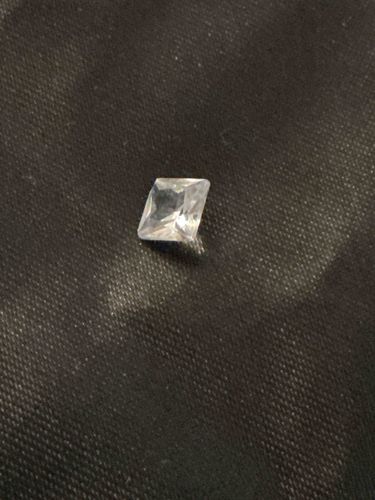
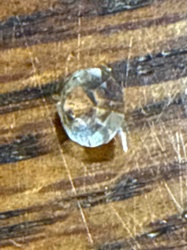
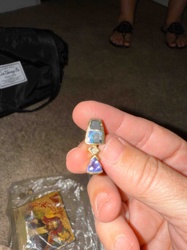
The item depicted is a single, clear, faceted gemstone, possibly a diamond or a diamond imitation such as cubic zirconia or moissanite. It is cut in a 'princess cut' style, characterized by its square or rectangular shape with multifaceted sides, designed to maximize brilliance. The observed color is transparent and colorless, appearing bright and reflective against the dark, textured fabric background. Its dimensions appear to be small, likely under 1 carat, given the visual scale. The facets are clearly visible, indicating a well-executed cut that allows light to reflect internally. There are no discernible inclusions or blemishes visible from the image, suggesting either high clarity or the excellent light-reflecting properties of its material. No specific manufacturing marks, hallmarks, or inscriptions are visible, as would be expected for a loose gemstone. The condition appears to be excellent, with no apparent chips, scratches, or wear on its surfaces. The absence of a setting suggests it is a loose stone, intended for future mounting or as a sample. The origin or exact material cannot be definitively determined without specialized gemological testing, but its bright luster and geometric cut are typical of modern jewelry stones. Based on the cut and visual properties, it is likely a relatively modern item, designed to appeal to contemporary aesthetic preferences for sparkle and clean lines. The quality of its polish appears high, contributing to its overall brilliance.
AI Appraisal Report
I have examined the provided image of what appears to be a clear, faceted, princess-cut gemstone. Visually, the stone exhibits excellent clarity and brilliance, with no apparent inclusions or blemishes captured in the photograph. The cut quality appears high, maximizing light reflection, which is a hallmark of good facet arrangement. Its 'colorless' appearance is also a positive attribute. The condition is excellent, showing no chips, scratches, or wear.
However, it is crucial to state that based solely on this image, definitive authenticity as a natural diamond versus a diamond simulant (such as cubic zirconia, moissanite, or synthetic sapphire) cannot be established. For example, a small, well-cut cubic zirconia or white sapphire can exhibit similar visual properties to a diamond in an image. The size appears small, likely under 1 carat. Without specialized gemological testing, such as refractometer measurements, thermal conductivity tests, or microscopic examination for internal characteristics unique to diamonds, I cannot confirm its material.
Market conditions for loose, small, colorless princess-cut stones vary drastically depending on the material. If this were a natural diamond of good quality (e.g., G-H color, VS clarity) and under 0.25 carats, its value could range from $200-$500. However, given the strong possibility of it being a simulant based on image-only examination, the market value for such an item is considerably lower. Demand for well-cut simulants exists, but rarity is not a factor. Therefore, assuming it is a high-quality imitation, due to the lack of verifiable diamond characteristics, I estimate a conservative appraisal range.
For full authentication, a hands-on examination by a certified gemologist is absolutely necessary. This would involve specific gravity tests, detailed microscopic analysis, and potentially spectroscopy to ascertain its true identity, and thus, its accurate market value.