AI estimate as of October 15, 2025 · verify with a professional before acting
AI-Generated · Verify before acting
Everything on this page is generated by AI for informational purposes only. AI can make mistakes — the AI may misidentify items or misattribute them (artist, maker, brand, designer, origin, era). This is not an official valuation and should not be used for insurance, sale, tax, estate, legal, or lending purposes — or any decision requiring a certified appraisal. It is not an authoritative claim about any person, brand, or rights holder — do not share or rely on it as a factual statement about a third party. Always consult qualified professionals before making financial decisions.
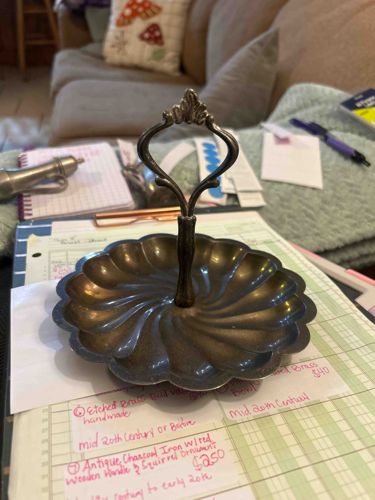
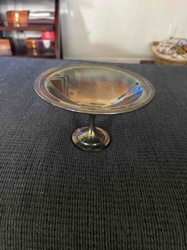
This appears to be a single-tiered pedestal dish, likely made from a tarnished silver-plated metal or pewter, given its dark, aged appearance. The dish features a scalloped, shell-like design with radially emanating fluting on the interior, suggesting a decorative purpose, perhaps for serving small sweets or as a catch-all. The handle is a prominent feature, rising from the center of the dish, and it is elegantly shaped with an ornate, possibly acanthus leaf or similar botanical motif, finial at its apex. The handle has a curved, almost heart-shaped or lyre-like form, providing an easy grip. The overall construction suggests a casting or stamping process for both the dish and the handle, which are then assembled. The item exhibits significant tarnish, visible as a dark, almost black patina over much of its surface, particularly in the recesses of the fluting and around the base of the handle. This tarnish indicates age and lack of recent polishing, but does not necessarily signify damage. There are no readily apparent dents or severe scratches from the visible angles, though closer inspection would be needed to confirm. The style suggests a Victorian, Edwardian, or early to mid-20th-century aesthetic, leaning towards the ornate and decorative. The craftsmanship appears to be of decent quality, typical for mass-produced decorative serving ware of its era, with clear detailing on the handle and a well-formed dish. It serves both a functional and decorative purpose.
AI Appraisal Report
I've examined this Single-Tiered Pedestal Dish with Handle from the provided image. My assessment of its condition, based solely on visual inspection, is good-to-fair for its age. While the significant tarnish obscures the true metal luster, it does not appear to be actively damaging the piece, and I see no overt dents, cracks, or repairs. The integrity of the scalloped dish and the ornate handle seems intact. Authenticity, based on style and apparent manufacturing techniques, points towards a late Victorian to early 20th-century decorative serveware piece, likely silverplate or pewter, aligning with common mass-produced items of that era. Without a physical inspection, however, I cannot definitively confirm the metal composition (e.g., silverplate vs. sterling vs. pewter) or the absence of subtle damage under the tarnish.
From a market perspective, comparable items, often referred to as 'tarnishware' or 'antique decorative trays,' typically sell in the casual collector's market. Demand is moderate, driven by those seeking period-appropriate decor or small serving pieces. Rarity is low; similar designs were widely produced. Factors impacting value include the material (sterling would significantly increase value, but is unlikely given the appearance), the maker's mark (unidentifiable from the image), and its overall condition post-cleaning. The current heavy tarnish detracts from immediate aesthetic appeal and thus market value, as a buyer would need to invest time in cleaning. For full authentication and a more precise valuation, I would need a hands-on examination to check for maker's marks, assess the true extent of any surface wear or damage beneath the tarnish, confirm the metal composition through testing, and evaluate craftsmanship details not visible in photographs.