AI Appraisal Estimate

AI-generated estimates · not official valuations

From the user

What was submitted

Photo and notes provided by the user — not generated by AI

Submitted item photo
Submitted photo · May 16, 2026

User's notes

No additional notes provided.

AI analysis below

AI appraisal

AI analysis & estimate

AI-Generated · Verify before acting

Everything below is generated by AI for informational purposes only. AI can make mistakes — the AI may misidentify items or misattribute them (artist, maker, brand, designer, origin, era). This is not an official valuation and should not be used for insurance, sale, tax, estate, legal, or lending purposes — or any decision requiring a certified appraisal. It is not an authoritative claim about any person, brand, or rights holder — do not share or rely on it as a factual statement about a third party. Always consult qualified professionals before making financial decisions.

Read the full disclaimer

AI Identification

·Not independently authenticated·Verify before acting

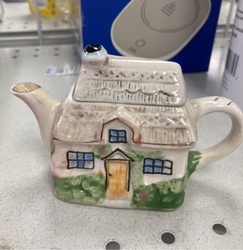
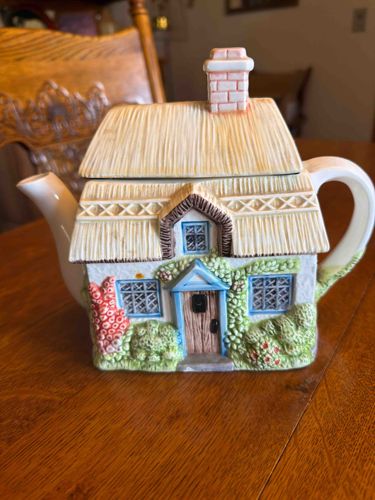
Vintage Price & Kensington Cottage Ware Teapot

Antique and Vintage Ceramics / Teapots

AI Estimated Value

·Not an official valuation·Verify before acting

$35.00 - $60.00

As of May 16, 2026

AI Item Analysis

·AI can make mistakes·Verify before acting
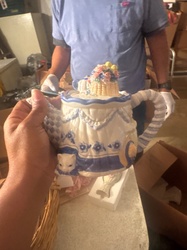
This is a novelty ceramic teapot designed in the traditional English 'Cottage Ware' style, likely manufactured by Price & Kensington or a similar British pottery firm such as Lingard Webster. The teapot is crafted from glazed earthenware and features a highly textured, three-dimensional design mimicking a country cottage. The lower body serves as the house structure, featuring relief-molded details of a wooden front door with a blue gabled porch, lattice-pane windows, and lush garden greenery including green bushes and pink floral accents. The lid is uniquely integrated into the design as the thatched roof, complete with a brick-patterned chimney stack that functions as the handle for removal. The spout and main handle are finished in a simple white glaze, contrasting with the detailed polychrome painting of the cottage. The color palette consists of cream, earthy tans, sky blue, moss green, and terracotta. The craftsmanship shows typical mid-20th-century mass-production quality with hand-painted accents that vary slightly between pieces. This item appears to be in good vintage condition with no major chips or cracks visible, though common issues for this age include fine crazing in the glaze and minor shelf wear on the unglazed base. The style is quintessential mid-century decorative kitchenware, popular from the 1940s through the 1960s.
AI Appraisal Report

·AI can make mistakes·Verify before acting
I have virtually examined this 'Cottage Ware' teapot, a quintessential example of mid-20th-century British earthenware. The design, featuring a thatched-roof lid and relief-molded garden details, is characteristic of Price & Kensington or Ye Olde Cottage styles popular between 1940 and 1960. Visually, the piece appears to be in 'Good to Very Good' vintage condition. The glaze retains a high gloss, and the polychrome hand-painted accents show minimal fading. I note some expected darkening near the base, likely minor shelf wear or light staining consistent with age. Authentication via imagery suggests this is an original mass-produced piece rather than a modern reproduction, evidenced by the specific 'Ye Olde Cottage' aesthetic and the shape of the chimney finial. The market for Cottage Ware is currently stable but saturated; these items were produced in high volumes, making them readily available to collectors. Recent auction comparables for single teapots in excellent condition typically fall within the $35 to $60 range. Sets including creamers or sugar bowls carry a premium. Factors limiting value include the commonality of the design and the presence of fine crazing, which is nearly universal in this type of earthenware. For a definitive authentication, an in-person inspection is required to check for hidden hairline cracks, professional restorations, and the presence of an underside backstamp (such as 'Price Kensington, Made in England'). While this image strongly suggests authenticity, only physical handling can confirm the absence of internal structural damage or chemical leaching if used for functional purposes.

Get your items appraised

Instant estimates of your treasures with AI-powered appraisals

Browse More Appraisals