AI Appraisal Estimate

AI-generated estimates · not official valuations

From the user

What was submitted

Photo and notes provided by the user — not generated by AI

Submitted item photo
Submitted photo · June 3, 2026

User's notes

No additional notes provided.

AI analysis below

AI appraisal

AI analysis & estimate

AI-Generated · Verify before acting

Everything below is generated by AI for informational purposes only. AI can make mistakes — the AI may misidentify items or misattribute them (artist, maker, brand, designer, origin, era). This is not an official valuation and should not be used for insurance, sale, tax, estate, legal, or lending purposes — or any decision requiring a certified appraisal. It is not an authoritative claim about any person, brand, or rights holder — do not share or rely on it as a factual statement about a third party. Always consult qualified professionals before making financial decisions.

Read the full disclaimer

AI Identification

·Not independently authenticated·Verify before acting

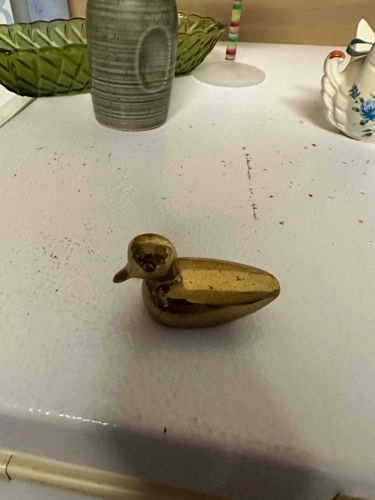
Brass Duck Figurine

Decorative Figurine

AI Estimated Value

·Not an official valuation·Verify before acting

$30 - $70

As of June 3, 2026

AI Item Analysis

·AI can make mistakes·Verify before acting
This is a small, solid brass figurine depicting a duck. The item exhibits a rich, golden-brown metallic color characteristic of aged brass. Its construction appears to be a single, cast piece, showcasing a smooth, polished finish that has developed a natural patina over time, evidenced by darker areas and minor splotches on its surface. The duck is rendered in a simplified, somewhat abstract style, with smooth, rounded contours forming its body. Distinct features include a small head with a defined beak and what appear to be inset or engraved eyes, although the detail is subtle. The body of the duck is elongated and symmetrical, tapering towards the tail. There are no obvious maker's marks, signatures, or stamps visible from the provided image. The visible condition suggests some surface wear consistent with handling and age, including minor scratches or abrasions that don't detract significantly from its aesthetic appeal but indicate use rather than pristine, display-only preservation. Given its material and typical decorative styles, it likely dates from the mid-20th century, possibly the 1950s to 1970s. Its small scale suggests it could be used as a paperweight, desk ornament, or a decorative accent piece. The craftsmanship, while not excessively intricate, appears solid and well-executed for its purpose, indicating a quality decorative item.

AI Appraisal Report

·AI can make mistakes·Verify before acting
This charming brass duck figurine, based on my visual examination, appears to be a solid cast piece, characteristically aged with a rich golden-brown patina. The smooth, rounded contours and simplified style suggest mid-20th-century production, likely 1950s-1970s. The surface exhibits minor scratches and splotches, consistent with age and handling, indicating use rather than being purely ornamental. These small imperfections do not significantly detract from its aesthetic appeal, supporting its authenticity as an aged decorative item. Its small scale makes it suitable as a paperweight or desk ornament. Market conditions for such brass decorative items are generally moderate. While brass figurines are common, those with appealing forms like this duck maintain a steady, albeit modest, demand among collectors of vintage home decor. Rarity is not a significant factor here; similar items by unidentified makers are relatively abundant. The absence of maker's marks or signatures limits its value, as branded pieces typically command higher prices. Comparables in the online vintage market (Etsy, eBay, antique malls) for similar unbranded solid brass animal figurines typically range from $25 to $75, depending on size, condition, and aesthetic appeal. The primary factor impacting its value is its aesthetic appeal as a well-executed vintage decorative item. The lack of provenance or an identifiable maker prevents it from reaching higher values associated with known designers or manufacturers. For full authentication and to ascertain precise material composition or manufacturing techniques, a physical inspection would be required to assess weight, apply non-invasive tests for material verification, and search for extremely subtle marks not visible in images alone. Without this, my assessment of age and material remains based purely on visual characteristics consistent with known examples.

Get your items appraised

Instant estimates of your treasures with AI-powered appraisals

Browse More Appraisals