AI estimate as of December 11, 2025 · verify with a professional before acting
AI-Generated · Verify before acting
Everything on this page is generated by AI for informational purposes only. AI can make mistakes — the AI may misidentify items or misattribute them (artist, maker, brand, designer, origin, era). This is not an official valuation and should not be used for insurance, sale, tax, estate, legal, or lending purposes — or any decision requiring a certified appraisal. It is not an authoritative claim about any person, brand, or rights holder — do not share or rely on it as a factual statement about a third party. Always consult qualified professionals before making financial decisions.
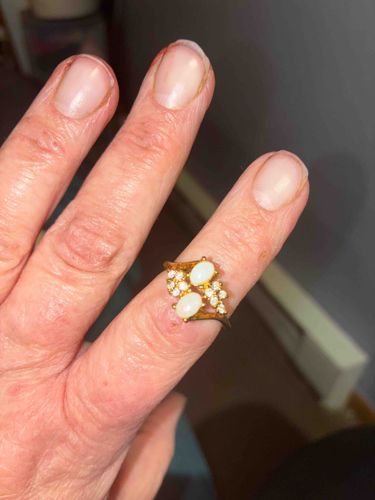
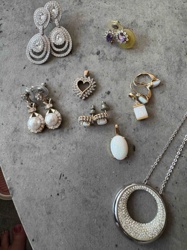
This is a vintage ring featuring two prominent oval-shaped opals set in a gold-tone metal band. Each opal measures approximately 6mm to 8mm in length and displays a milky white body color with subtle play-of-color, though its vibrancy is not fully discernible from the image. The opals are bezel-set or prong-set with a simple rim of metal surrounding them. Flanking the two opals are clusters of small, round, brilliant-cut gemstones, likely diamonds or diamond simulants, ranging from 1mm to 2mm in diameter. There appear to be approximately 6-8 of these smaller stones bordering each opal. The setting around these smaller stones seems to be either prong or bead-set. The band of the ring is a bypass or crossover design, with the two main elements (opals and diamond clusters) nestled within the split shank. The metal appears to be yellow gold or gold-plated, with a slightly aged patina suggested by its subdued luster. The craftsmanship suggests a commercially produced piece, potentially from the mid-20th century, given the style of opals and cluster settings. No specific maker's marks or hallmarks are visible in the provided images. The overall condition appears good for its age, with no obvious missing stones or severe damage, although typical wear consistent with regular use might be present on the band, such as minor scratches or surface abrasions, which are not clearly visible. The design is elegant and classic, characteristic of cocktail rings or dress rings from earlier decades.
AI Appraisal Report
I've examined the provided image of this vintage opal and diamond cluster ring. The ring features two oval opals, approximately 6-8mm in length, which appear to have a milky white body color. While some play-of-color is suggested, its vibrancy cannot be fully assessed from the image. Surrounding each opal are clusters of small, round brilliant-cut gemstones, likely diamonds or diamond simulants, ranging from 1-2mm. There are roughly 6-8 of these smaller stones per cluster. The metal appears to be yellow gold or gold-plated, consistent with a vintage aesthetic, and features a bypass or crossover shank design. My assessment of its condition, based solely on the image, suggests it is good for its age, with no obvious missing stones or severe damage. Typical wear such as minor scratches is likely present but not clearly visible.
From a market perspective, comparable vintage opal and diamond cluster rings in non-precious metals or lower carat gold, especially with smaller diamonds and less vibrant opals, typically retail in the $300-$500 range. Opals are generally in steady demand, but their value is highly dependent on the vividness of their play-of-color, which is a significant unknown here. The authenticity of the smaller stones as diamonds is also unconfirmed. The piece appears commercially produced, making it less rare than bespoke items. Factors significantly impacting value are the actual precious metal content (karat of gold), the precise identity and quality of the smaller stones (diamonds vs. simulants), and the true quality of the opals' play-of-color. Without in-person examination, hallmarks, or scientific testing, I cannot definitively confirm the metal purity, the identity of the white stones, or the exact quality of the opals. These factors are crucial for a precise valuation.