These notes were written by the person who submitted this item. Appraiser.AI has not verified them, and the AI's identification and estimate may rely on them.
AI Estimated Value
Not an official valuation
$15-$30
AI estimate as of November 3, 2025 · verify with a professional before acting
AI-Generated · Verify before acting
Everything on this page is generated by AI for informational purposes only. AI can make mistakes — the AI may misidentify items or misattribute them (artist, maker, brand, designer, origin, era). This is not an official valuation and should not be used for insurance, sale, tax, estate, legal, or lending purposes — or any decision requiring a certified appraisal. It is not an authoritative claim about any person, brand, or rights holder — do not share or rely on it as a factual statement about a third party. Always consult qualified professionals before making financial decisions.
This analysis also relies on unverified notes provided by the user, which may be incomplete or inaccurate and could affect the result.
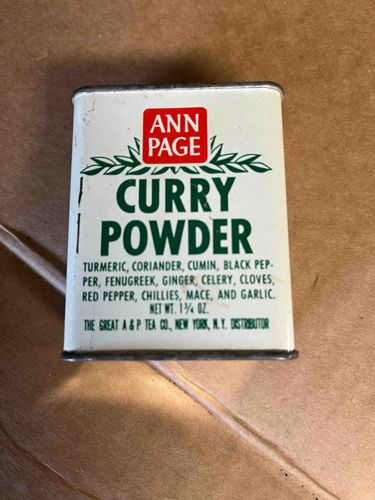
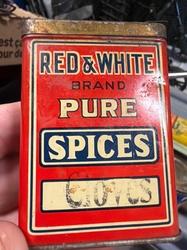
This item is a vintage rectangular tin for Ann Page Curry Powder, likely dating from the mid-20th century, possibly the 1950s or 1960s, given the 'Ann Page' branding associated with The Great A & P Tea Co. The tin features a cream or off-white background with bold green and red text. The brand name 'ANN PAGE' is prominently displayed in a red rectangular box at the top, above a green leafy design. Below this, 'CURRY POWDER' is printed in large, sans-serif green letters. Further down, the ingredients list is visible in smaller black text: 'TURMERIC, CORIANDER, CUMIN, BLACK PEPPER, FENUGREEK, GINGER, CELERY, CLOVES, RED PEPPER, CHILLIES, MACE, AND GARLIC.' The net weight is indicated as 'NET WT. 1 1/8 OZ.' At the very bottom, it states 'THE GREAT A & P TEA CO., NEW YORK, N.Y. DISTRIBUTOR' in smaller green text. The tin appears to be constructed from metal, likely steel or tin-plated steel, with crimped seams visible along the edges, indicating standard manufacturing practices for spice tins of that era. The visible condition suggests some wear consistent with age and storage, including minor surface scuffs and possibly slight discoloration of the cream background. There are no obvious signs of significant dents, rust, or major paint loss, but a detailed inspection would be needed to confirm. The aesthetic is characteristic of vintage grocery packaging, prior to the widespread use of plastic containers, making it a collectible piece for those interested in mid-century advertising and kitchenalia. The distinct color scheme and clear typography are hallmarks of commercial packaging designed for easy readability on store shelves.
AI Appraisal Report
Based on my visual examination of the provided image and the owner's description, this Ann Page Curry Powder Tin appears to be an authentic mid-century spice tin, likely from the 1950s or 1960s, consistent with 'The Great A & P Tea Co.' branding. The design, including the prominent 'ANN PAGE' logo, green and red color scheme, and detailed ingredient list, aligns with typical grocery packaging from that era. The construction, with visible crimped seams, further supports its vintage authenticity.
The condition, as described, suggests minor wear such as surface scuffs and possible discoloration, which is typical for an item of this age. Crucially, the absence of significant dents, rust, or major paint loss is a positive factor for its collectible appeal.
In terms of market conditions, vintage spice tins, while collectible, generally fall into a niche market. Comparables for similar Ann Page tins or other Great A&P Tea Co. spice tins in good condition typically fetch between $15 and $30 on online marketplaces and at antique shows. Factors impacting value include the brand recognition (Ann Page is reasonably well-known), the attractive graphic design, and the overall state of preservation. Demand is moderate, driven by collectors of vintage kitchenalia, advertising memorabilia, or A&P ephemera. It is not considered particularly rare.
It is important to note that this appraisal is based solely on the provided image and description. Full authentication and a more precise condition assessment would require in-person examination to detect subtle dents, specific areas of paint loss, or any potential restoration. Provenance documentation, while helpful for unique or higher-value items, is less critical for a common collectible like this spice tin. No scientific testing would typically be performed for such an item.