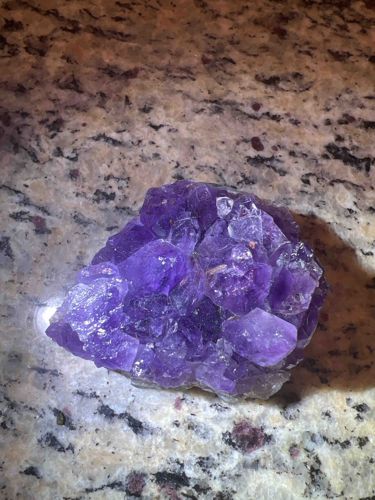
Amethyst Quartz Cluster
This specimen is a raw amethyst quartz cluster, characterized by its vibrant purple hue ranging from deep violet to lighter lavender tones. The piece consists of a dense grouping of natural, interlocking crystalline points emerging from a common matrix base. The crystals exhibit the typical hexagonal prism structure of quartz, though many of the terminations appear fractured or naturally irregular. The material displays high transparency in several sections, allowing light to penetrate the crystal geometry, while other areas are more opaque with internal inclusions and veining. The exterior facets show a vitreous luster that catches the light across the uneven surface. In terms of condition, the specimen appears largely in its natural state, showing some edge wear and minor chipping along the crystal points, which is common for geological samples handled outside of professional museum settings. There are no apparent artificial modifications or dye treatments visible, suggesting a natural origin. The base of the cluster shows a grayish, stony matrix characteristic of the geode walls where such crystals typically form. The overall craftsmanship is dictated by nature, with the value being determined by the saturation of color, the size of individual points, and the overall aesthetic balance of the cluster.
AI-Generated Appraisal Disclaimer
Estimated Value
$150 - $225
Basic Information
Category
Rocks, Fossils & Minerals
Appraised On
February 6, 2026
Estimated Value
$150 - $225
Item Description
This specimen is a raw amethyst quartz cluster, characterized by its vibrant purple hue ranging from deep violet to lighter lavender tones. The piece consists of a dense grouping of natural, interlocking crystalline points emerging from a common matrix base. The crystals exhibit the typical hexagonal prism structure of quartz, though many of the terminations appear fractured or naturally irregular. The material displays high transparency in several sections, allowing light to penetrate the crystal geometry, while other areas are more opaque with internal inclusions and veining. The exterior facets show a vitreous luster that catches the light across the uneven surface. In terms of condition, the specimen appears largely in its natural state, showing some edge wear and minor chipping along the crystal points, which is common for geological samples handled outside of professional museum settings. There are no apparent artificial modifications or dye treatments visible, suggesting a natural origin. The base of the cluster shows a grayish, stony matrix characteristic of the geode walls where such crystals typically form. The overall craftsmanship is dictated by nature, with the value being determined by the saturation of color, the size of individual points, and the overall aesthetic balance of the cluster.
Get Your Items Appraised
Instant estimates of your treasures with AI-powered instant appraisals