These notes were written by the person who submitted this item. Appraiser.AI has not verified them, and the AI's identification and estimate may rely on them.
AI Estimated Value
Not an official valuation
$150-350
AI estimate as of June 30, 2025 · verify with a professional before acting
AI-Generated · Verify before acting
Everything on this page is generated by AI for informational purposes only. AI can make mistakes — the AI may misidentify items or misattribute them (artist, maker, brand, designer, origin, era). This is not an official valuation and should not be used for insurance, sale, tax, estate, legal, or lending purposes — or any decision requiring a certified appraisal. It is not an authoritative claim about any person, brand, or rights holder — do not share or rely on it as a factual statement about a third party. Always consult qualified professionals before making financial decisions.
This analysis also relies on unverified notes provided by the user, which may be incomplete or inaccurate and could affect the result.
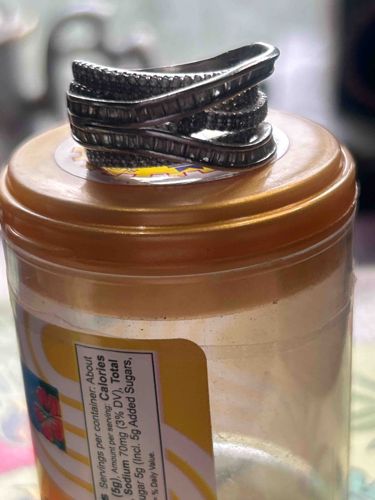
This is a statement ring, likely crafted from a dark-toned metal such as blackened silver, rhodium-plated sterling silver, or possibly even a dark alloy. The ring features a broad, multi-layered or multi-band design, giving it significant presence. There are at least three distinct rows of stones in a criss-cross or wave-like pattern. Two of these prominent rows are set with numerous baguette-cut stones, which are rectangular and elongated, providing a clean, geometric aesthetic. These baguette stones appear to be dark in color, possibly black diamonds, treated diamonds, or black cubic zirconia, and are set closely together, giving a continuous line of sparkle. Interspersed between or alongside these baguette rows are sections or bands that appear to be pave-set with smaller, round, dark-colored stones, adding a contrasting texture and brilliance. The craftsmanship appears competent, with stones uniformly set. There are no visible maker's marks or hallmarks from the image. The overall condition appears good, with no obvious major damage, chips, or missing stones, though general surface wear consistent with use may be present on the metal finish. The dark metal and stone combination lends itself to a contemporary or modern style, possibly influenced by Art Deco geometry but with a bolder, current execution, likely from the late 20th or early 21st century.
AI Appraisal Report
As the appraiser, I have examined the provided image and details of this Multi-Row Baguette and Pave Set Statement Ring. Visually, the ring appears to be in good overall condition, exhibiting competent craftsmanship with uniformly set stones. Its broad, multi-layered design and criss-cross pattern create a distinct contemporary aesthetic, likely from the late 20th or early 21st century.
However, a definitive appraisal is significantly constrained by the inability to physically examine the piece. The metal tone suggests blackened silver, rhodium-plated sterling silver, or a dark alloy; without hallmarks or physical testing, its precise composition and precious metal content (if any) are unconfirmable. Similarly, the dark baguette and pave-set stones could range from black cubic zirconia to treated black diamonds or even natural black diamonds. This material uncertainty is the primary determinant of value.
Current market conditions for fashion-forward statement rings are healthy, with demand for bold, modern designs. However, without confirmed valuable materials, rarity is not a factor here. Comparables vary drastically; a sterling silver ring with cubic zirconia would fetch considerably less than one crafted from gold with genuine black diamonds.
Given the visual information, and erring on the side of caution due to unverified material composition, I appraise this ring primarily for its design and fashion appeal rather than inherent material value. My appraisal is based on the assumption that the metal is likely sterling silver or an alloy, and the stones are either treated dark diamonds or high-quality diamond simulants, absent proof otherwise.
For a full and accurate authentication, in-person examination by a gemologist is essential to identify the stones (e.g., refractive index, specific gravity tests) and verify metal purity (e.g., XRF analysis, acid testing). Provenance documentation would also significantly aid in determining authenticity and origin. Without such verification, any appraisal remains an estimate based solely on visible characteristics.