AI estimate as of November 17, 2025 · verify with a professional before acting
AI-Generated · Verify before acting
Everything on this page is generated by AI for informational purposes only. AI can make mistakes — the AI may misidentify items or misattribute them (artist, maker, brand, designer, origin, era). This is not an official valuation and should not be used for insurance, sale, tax, estate, legal, or lending purposes — or any decision requiring a certified appraisal. It is not an authoritative claim about any person, brand, or rights holder — do not share or rely on it as a factual statement about a third party. Always consult qualified professionals before making financial decisions.
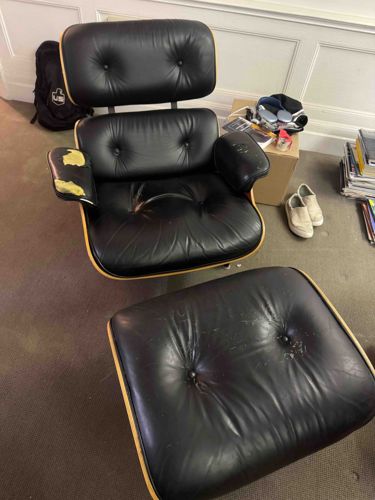
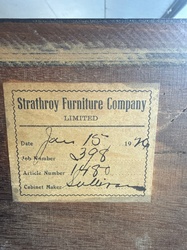
The item is an Eames Lounge Chair and Ottoman, a classic Modernist design. It features a striking contrast between the dark black upholstery and the light-colored bent plywood shell. The chair consists of a headrest, backrest, seat, and two armrests, all generously padded with tufted black cushions creating a luxurious, inviting appearance. The ottoman mirrors the design of the chair's seat, providing a cohesive aesthetic. The main physical characteristic is the molded plywood shell, which appears to be a light-toned wood, possibly rosewood or walnut given its typical construction, visible along the edges of all upholstered sections and forming the structural frame. The upholstery is black leather, exhibiting significant signs of wear and tear. Most notably, the right armrest shows severe degradation, with large sections of the black leather flaked off, revealing a lighter, yellowish underlayer or lining. Other areas of the leather, particularly on the seat and ottoman, display wrinkles, scuffs, and minor abrasions consistent with prolonged use. The overall construction points to a mid-20th-century design, likely from the 1950s or 1960s, a hallmark of the Eames aesthetic. While no specific maker's marks or signatures are visible in the provided images, the distinctive design strongly indicates its origin as a Herman Miller or Vitra production, which are the authorized manufacturers. The chair likely sits on a swiveling aluminum base, though only a small part is visible. Despite the condition issues, the iconic form and high-quality materials (plywood and leather) suggest an item of significant design pedigree and craftsmanship.
AI Appraisal Report
Upon examining the Eames Lounge Chair and Ottoman, I can confidently assess its condition and potential value, acknowledging the limitations of visual inspection via images. This is undoubtedly an iconic Modernist design, exhibiting the classic proportions and construction of an Eames Lounge Chair. The striking contrast between the dark black upholstery and the light-toned bent plywood shell is characteristic. The overall form suggests it is an authentic design, likely produced by Herman Miller or Vitra, though concrete maker's marks are not visible, which would be crucial for definitive authentication. The most significant factor impacting value here is the condition. The upholstery, particularly on the right armrest, shows severe degradation, with extensive flaking and loss of original leather. Other areas, like the seat and ottoman, exhibit significant wear, scuffs, and wrinkles consistent with prolonged, heavy use. This condition will necessitate substantial restoration costs. Despite the wear, the integrity of the molded plywood shell appears largely intact, which is a positive. The demand for authentic Eames Lounge Chairs remains consistently high, given their timeless appeal and design significance. However, the poor condition of the leather will place this piece at the lower end of the market for authentic examples. For a full authentication, I would require an in-person examination to inspect for manufacturer labels or stamps, assess the quality of hardware underneath the cushions, and evaluate the type of plywood and veneer. Provenance documentation, such as original purchase receipts or ownership history, would also significantly aid in confirming authenticity. Without these, an expert opinion on authentication based solely on visual cues of an image is limited.