AI estimate as of December 10, 2025 · verify with a professional before acting
AI-Generated · Verify before acting
Everything on this page is generated by AI for informational purposes only. AI can make mistakes — the AI may misidentify items or misattribute them (artist, maker, brand, designer, origin, era). This is not an official valuation and should not be used for insurance, sale, tax, estate, legal, or lending purposes — or any decision requiring a certified appraisal. It is not an authoritative claim about any person, brand, or rights holder — do not share or rely on it as a factual statement about a third party. Always consult qualified professionals before making financial decisions.
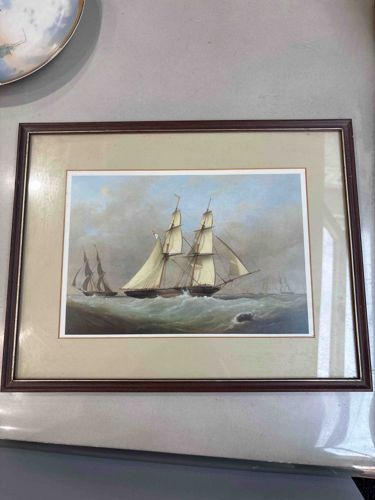
This item is a framed print depicting a seascape with tall ships. The central and most prominent vessel is a two-masted sailing ship, likely a brig or schooner, with full sails aloft, rendered in shades of cream and light beige, suggesting canvas or linen. The ship itself has a dark hull, possibly black or dark brown, with lighter detailing that could represent deck structures or rigging. It is depicted cutting through choppy, dark green and blue-grey waves, characteristic of a rough sea, with white foam and spray indicating movement and impact. In the background, to the left, another smaller, less detailed tall ship is visible, sailing further away, suggesting a fleet or concurrent voyage. The sky above is a blend of pale blue and various shades of grey, indicating an overcast or dramatic weather condition. The print is housed within a rectangular frame made of dark brown wood or a wood-like material, possibly stained or painted. The frame has a simple, clean profile. Inside the frame, a cream-colored or light beige mat board surrounds the print, providing a border that separates the artwork from the frame and enhances its presentation. The overall condition appears good, with no obvious signs of significant damage to the print itself or the frame. Given the framing and subject matter, the print likely dates from the mid-20th century to the early 21st century, focusing on traditional maritime themes. The quality of the print and framing appears standard for mass-produced decorative art.
AI Appraisal Report
I have examined the provided image of this framed tall ship seascape print. Based on visual assessment, the print appears to be in good overall condition, with no obvious tears, significant discoloration, or heavy foxing. The dark wooden frame and cream-colored mat board also seem to be in good condition, showing no major scuffs, chips, or water damage that would detract from its presentation. Authenticity, in terms of it being an original print versus a reproduction of an existing artwork, is difficult to ascertain solely from an image. It presents as a decorative art print, likely mass-produced, given the typical framing and subject matter. Without examining signatures, edition numbers, or print quality up close, it's impossible to confirm if it's a limited edition, an open edition, or a later reproduction of an older piece. Market conditions for decorative seascape prints featuring tall ships are generally stable but not exceptionally strong for generic pieces. There is a consistent demand for classic maritime themes, particularly in certain décor styles. However, the market is saturated with similar items, especially those produced from the mid-20th century onwards. This affects rarity; such prints are not rare, as many were created for home and office decoration. Factors significantly impacting value include the lack of a known artist, publisher, or specific historical significance. The print's appeal is primarily decorative. A higher value would require a known artist, a limited edition number, or exceptional quality of the print medium itself. For full authentication and a more precise valuation, an in-person examination would be critical to inspect the print medium, look for a signature or edition number, assess paper quality and age, and check for any publisher marks. Provenance documentation, if available, stating the artist or original source, would also be invaluable. Without these, I must appraise it as a standard decorative print.