These notes were written by the person who submitted this item. Appraiser.AI has not verified them, and the AI's identification and estimate may rely on them.
AI Estimated Value
Not an official valuation
$20-35
AI estimate as of July 30, 2025 · verify with a professional before acting
AI-Generated · Verify before acting
Everything on this page is generated by AI for informational purposes only. AI can make mistakes — the AI may misidentify items or misattribute them (artist, maker, brand, designer, origin, era). This is not an official valuation and should not be used for insurance, sale, tax, estate, legal, or lending purposes — or any decision requiring a certified appraisal. It is not an authoritative claim about any person, brand, or rights holder — do not share or rely on it as a factual statement about a third party. Always consult qualified professionals before making financial decisions.
This analysis also relies on unverified notes provided by the user, which may be incomplete or inaccurate and could affect the result.
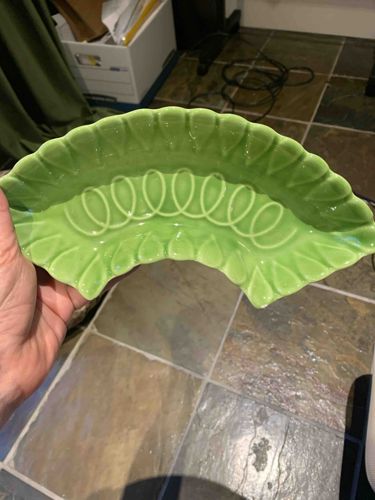
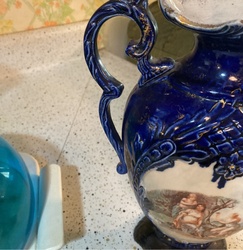
This item is a decorative ceramic dish, likely in the form of a serving dish, candy dish, or trinket holder. It is crafted from glazed ceramic or pottery and features a vibrant, somewhat iridescent lime green or light apple green color across its entire visible surface. The dish has a distinctive leaf-like or fan shape, with a scalloped, fluted rim that mimics the veins or edges of a broad leaf. The interior of the dish is concave and is adorned with raised, stylized spiral or scroll patterns that run centrally along its length, creating an interesting tactile and visual texture. Surrounding these central spirals are further raised details, possibly representing smaller leaf veins or decorative fluting. The exterior, or underside, is not clearly visible but typically would be flat or have a small foot base for stability. The glaze appears smooth and glossy, reflecting light, suggesting it is well-fired. There are no obvious chips, cracks, or significant abrasions visible on the top surface, indicating reasonable condition, though closer inspection of the edges and base would be required for a full condition report. The craftsmanship appears to be commercial grade, common for mid-20th century decorative ceramics. Based on the provided context "CALIF USA L56", it is highly probable that this item was manufactured in California, USA, with 'L56' potentially being a mold number, model number, or a date code (e.g., 1956). This points to an estimated age of mid-20th century, likely 1940s-1960s, aligning with the popularity of vibrant glazes and nature-inspired designs in American pottery during that era. The exact dimensions are not provided, but based on the hand holding it, it appears to be a medium-sized dish, roughly 8-12 inches in length.
AI Appraisal Report
Based on my visual examination of the images and the provided markings 'CALIF USA L56', I have assessed this item as a mid-century decorative ceramic leaf dish. The 'CALIF USA' stamp strongly indicates its origin from one of the numerous potteries operating in California during the mid-20th century, a prolific era for such decorative wares. The 'L56' is likely a mold or model number. The vibrant green glaze, leaf motif, and scrollwork are all characteristic of the 1940s-1960s period. From the images, the dish appears to be in good to very good condition, with no visible chips, cracks, or crazing on the primary surfaces, which is a key factor in its value. The market for mid-century California pottery is active but generally modest for common, unmarked, or lesser-known makers. Similar leaf-shaped dishes from potteries like McCoy, Haeger, or non-specific California producers are readily available. The value is driven primarily by its decorative appeal and condition rather than rarity. Its value is somewhat limited as it is not attributed to a highly sought-after designer or studio like Bauer or Pacific. While the piece appears authentic to its period, a definitive attribution to a specific pottery would require physical inspection of the clay body, weight, and any other subtle markings. Without this in-person examination, my assessment is based on the visual evidence provided.