AI Appraisal Estimate

AI-generated estimates · not official valuations

From the user

What was submitted

Photo and notes provided by the user — not generated by AI

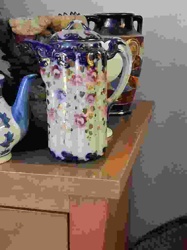
Submitted item photo
Submitted photo · May 27, 2026

User's notes

No additional notes provided.

AI analysis below

AI appraisal

AI analysis & estimate

AI-Generated · Verify before acting

Everything below is generated by AI for informational purposes only. AI can make mistakes — the AI may misidentify items or misattribute them (artist, maker, brand, designer, origin, era). This is not an official valuation and should not be used for insurance, sale, tax, estate, legal, or lending purposes — or any decision requiring a certified appraisal. It is not an authoritative claim about any person, brand, or rights holder — do not share or rely on it as a factual statement about a third party. Always consult qualified professionals before making financial decisions.

Read the full disclaimer

AI Identification

·Not independently authenticated·Verify before acting

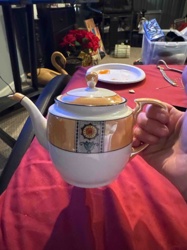
Vintage Japanese Satsuma-Style Moriage Porcelain Teapot

Antique Ceramics and Teaware

AI Estimated Value

·Not an official valuation·Verify before acting

$150 - $250

As of May 27, 2026

AI Item Analysis

·AI can make mistakes·Verify before acting
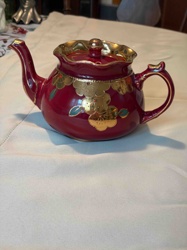
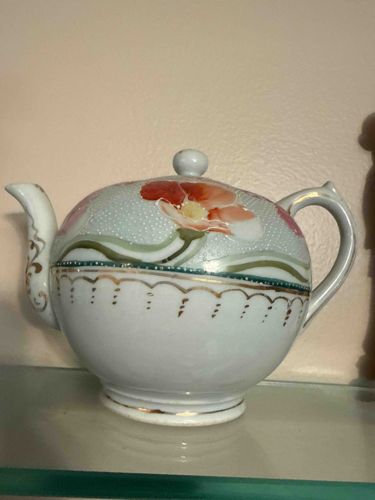
This is a globular-shaped porcelain teapot featuring heavy moriage (raised enamel) decoration, likely of Japanese origin and dating to the early-to-mid 20th century. The piece is constructed from a fine white porcelain with a slightly translucent glaze. The body is divided by a horizontal band of moriage beading and gilt scalloped patterns. The upper portion displays a prominent hand-painted floral motif, possibly a poppy or peony, in shades of terracotta and orange with sage green leaves. A distinguishing feature is the extensive 'dotted' moriage texture across the top hemisphere, giving it a beaded appearance. The teapot includes a fitted domed lid with a spherical finial and a curved handle and spout accented with gold gilt scrollwork. In terms of condition, there is visible crazing throughout the glaze, which is common in older Japanese ceramics. There is also noticeable wear to the gilt on the handle, spout, and trim, which suggests age and regular handling. No major chips or cracks are immediately evident in the photograph, though the foot rim shows minor shelf wear. The craftsmanship reflects a traditional export style meant to showcase intricate textural techniques.
AI Appraisal Report

·AI can make mistakes·Verify before acting
Based on my visual examination of the provided images, I have assessed this Japanese Satsuma-style moriage teapot. The piece showcases classic Taisho to early Showa era (c. 1920-1940) export characteristics, specifically the 'Beaded Moriage' technique often associated with the Nagoya region. The hand-painted floral motifs and heavy slip decoration are consistent with authentic period production for the Western market. The condition shows significant crazing and thinning of the gold gilt on the handle and spout, which is expected for its age but does temper the secondary market value. While the tactile density of the moriage is a sign of quality, the lack of a visible maker's mark (such as 'Noritake' or 'Royal Kinran') suggests a smaller kiln or unsigned export studio. The market for mid-tier Japanese export porcelain has stabilized; collectors currently favor pieces with pristine gilding or rare 'immortal' motifs over standard floral patterns. This item remains a desirable decorative specimen. However, as this appraisal is based on digital images, I must qualify these findings. A physical inspection is required to confirm the absence of 'hairline' cracks often hidden by crazing and to verify the resonance of the porcelain body. Furthermore, definitive authentication would require examining the foot rim under UV light to check for professional restorations and evaluating any marks on the underside. Scientific testing for glaze composition is rarely necessary for this era, but provenance documentation—such as a gift record or an original import receipt—would solidify its historical context and potentially increase the valuation ceiling.

Get your items appraised

Instant estimates of your treasures with AI-powered appraisals

Browse More Appraisals