AI estimate as of July 6, 2025 · verify with a professional before acting
AI-Generated · Verify before acting
Everything on this page is generated by AI for informational purposes only. AI can make mistakes — the AI may misidentify items or misattribute them (artist, maker, brand, designer, origin, era). This is not an official valuation and should not be used for insurance, sale, tax, estate, legal, or lending purposes — or any decision requiring a certified appraisal. It is not an authoritative claim about any person, brand, or rights holder — do not share or rely on it as a factual statement about a third party. Always consult qualified professionals before making financial decisions.
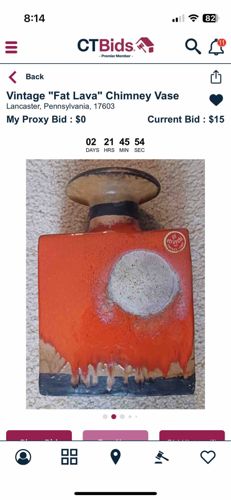
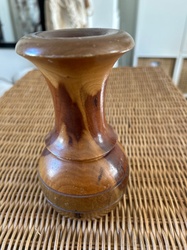
This is a vintage 'Fat Lava' chimney vase, likely dating from the mid-20th century, specifically the 1960s or 1970s, a period known for this distinctive glazing technique. The vase has a rectangular, block-like body with a flat base, transitioning to a cylindrical neck that flares out at the top into a wide, shallow, dish-like rim, resembling a 'chimney' design. The primary color of the body is a vibrant, glossy orange, characteristic of 'Fat Lava' glazes, which are thick and often exhibit a bubbly, textured surface. There is a prominent circular patch on one side, finished in a contrasting, granular, light gray or off-white glaze, creating a visual focal point. Towards the bottom, the orange glaze appears to drip or run downwards, interacting with an underlying dark, possibly black or very dark brown, base layer. Below this dark band, a lighter, earthy tone, possibly beige or light brown, is visible, suggesting the ceramic body itself. The rim of the vase shows some wear, with its yellowish-brown color and what appears to be a darkened edge, possibly from age or use. A red and white sticker, likely a manufacturer's label or import sticker, is visible on one side of the body, though its details are not clearly legible. The overall condition appears good for its age, with typical characteristics of eruption and texture inherent to the 'Fat Lava' style. The craftsmanship points to mass production though with unique glaze applications making each piece individual.
AI Appraisal Report
Based on my visual examination of the provided images, this item appears to be an authentic 'Fat Lava' style chimney vase, consistent with West German pottery from the 1960s or 1970s. The form, vibrant orange glaze with its characteristic thick, eruptive texture, and the contrasting granular patch are all hallmarks of this popular mid-century modern style. The condition appears to be good for its age, with typical crazing and glaze variations inherent to its production. The sticker, though illegible, is consistent with period labels.
The market for West German 'Fat Lava' ceramics remains active, driven by collectors of mid-century modern decor. While not exceptionally rare, this particular combination of a strong 'chimney' form and a vibrant, well-executed glaze is desirable. Current market comparables for similar 'Fat Lava' vases of this size and quality typically sell in the $75 to $150 range. The value is primarily driven by its decorative appeal and condition rather than the specific maker, which is unknown without a clear mark.
However, this appraisal is limited by the inability to physically inspect the piece. A full authentication would require an in-person examination to check for any hidden damage like hairline cracks, repairs, or chips not visible in the photos. I would also need to examine the base for any impressed or incised manufacturer's marks (e.g., Scheurich, Ruscha, Carstens) and clarify the details on the sticker, as a known, desirable maker could increase its value significantly. Without physical verification of makers' marks and condition, the value remains based on its general stylistic attributes.