AI identification & appraisal estimate

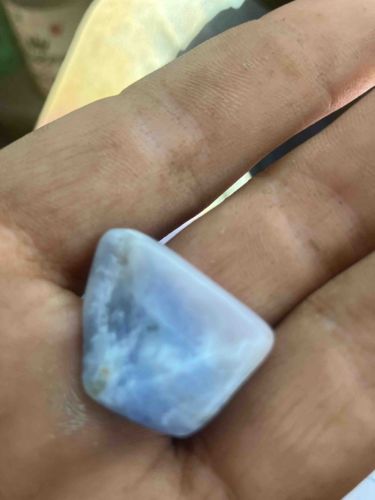
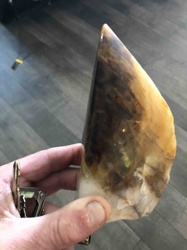
Tumbled Blue Lace Agate Specimen

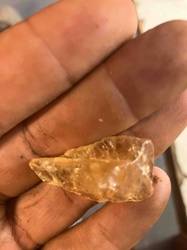
Submitted photo of Tumbled Blue Lace Agate Specimen
Photo submitted by the user — not generated by AI

AI Estimated Value

Not an official valuation

$15 - $30

AI estimate as of June 27, 2025 · verify with a professional before acting

AI-Generated · Verify before acting

Everything on this page is generated by AI for informational purposes only. AI can make mistakes — the AI may misidentify items or misattribute them (artist, maker, brand, designer, origin, era). This is not an official valuation and should not be used for insurance, sale, tax, estate, legal, or lending purposes — or any decision requiring a certified appraisal. It is not an authoritative claim about any person, brand, or rights holder — do not share or rely on it as a factual statement about a third party. Always consult qualified professionals before making financial decisions.

Read the full disclaimer

AI Item Analysis

This item is a tumbled or polished stone, likely a variety of chalcedony such as Blue Lace Agate, given its distinctive coloring. The stone exhibits a predominantly pale blue to lavender hue, interspersed with lighter, almost white, translucent bands and cloudy patterns, indicative of the 'lace' effect often seen in Blue Lace Agate. There are also subtle darker blue or grey inclusions, and a small yellowish-brown inclusion or discoloration visible on one edge, which might be a natural mineral inclusion or a surface stain. The stone is irregularly shaped, with rounded edges and a smooth, polished surface that reflects light, suggesting it has undergone tumbling or cabochon-style polishing to enhance its appearance and reveal its internal patterns. Its size appears to be suitable for holding in the palm of a hand, suggesting it's a relatively small, palm-sized specimen or a component for jewelry. The overall condition appears good, with no obvious chips, cracks, or significant abrasions from what is visible. The smooth, lustrous finish indicates good craftsmanship in its preparation. Without further testing, the exact mineral composition and origin cannot be precisely determined, but the visual characteristics strongly align with polished ornamental stones or semi-precious gemstones. The absence of maker's marks or signatures is typical for such natural items. Its aesthetic appeal lies in its soft coloration and natural patterns, making it desirable for collectors, spiritual practices, or use in handcrafted jewelry.
AI Appraisal Report

Upon visual examination of the provided image, I assess this tumbled stone as highly likely to be Blue Lace Agate, a variety of chalcedony. Its characteristic pale blue to lavender hues with lighter, translucent banding and cloudy patterns strongly align with the visual properties of this material. The smooth, polished surface and rounded edges indicate it has undergone tumbling or similar finishing, enhancing its aesthetic appeal and revealing its internal patterns. The condition appears very good, with no obvious chips or cracks visible. The minor yellowish-brown inclusion is likely natural and does not significantly detract from its overall appeal. Market conditions for tumbled stones like this are generally stable, with demand driven by collectors, metaphysical practitioners, and artisans for jewelry making. Compared to raw specimens, polished forms like this carry a higher value due to the labor involved in their preparation. While Blue Lace Agate is not exceedingly rare, high-quality specimens with distinct banding and good color saturation are more desirable. The 'lace' effect in this specimen is well-defined. Factors impacting value include the quality of the material itself (color, pattern distinctiveness), the quality of the polish, and its size. This specimen appears to be of good size for a tumbled stone. It is crucial to note that my assessment of authenticity is based solely on visual characteristics from the image. Without in-person examination, I cannot definitively verify its authenticity as Blue Lace Agate. A physical examination would allow for tactile inspection, assessment of specific gravity, and streak testing. For full authentication and to rule out potential imitations or dyed materials, advanced scientific testing such as X-ray diffraction (XRD) or Raman spectroscopy would be necessary to confirm the mineral composition. Provenance documentation would also add significant value and certainty regarding its origin.

Keep exploring

More mineral specimen / gemstone appraisals

Get your items appraised

Instant AI-powered appraisal estimates from a photo

Browse More Appraisals