AI estimate as of October 19, 2025 · verify with a professional before acting
AI-Generated · Verify before acting
Everything on this page is generated by AI for informational purposes only. AI can make mistakes — the AI may misidentify items or misattribute them (artist, maker, brand, designer, origin, era). This is not an official valuation and should not be used for insurance, sale, tax, estate, legal, or lending purposes — or any decision requiring a certified appraisal. It is not an authoritative claim about any person, brand, or rights holder — do not share or rely on it as a factual statement about a third party. Always consult qualified professionals before making financial decisions.
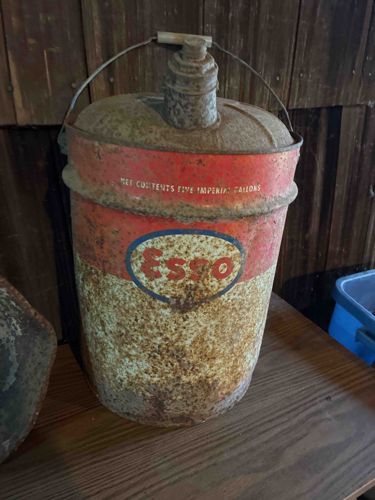
This is a vintage, cylindrical metal oil can, likely from the mid-20th century, bearing the 'Esso' brand logo. It appears to be constructed from sheet metal, with a rolled seam visible around the middle, indicating a two-part construction or reinforcement. The predominant colors are red and white, though much of the original paint has deteriorated. The top section of the can, roughly one-quarter of its height, clearly displays a faded red band with white lettering that reads 'NET CONTENTS FIVE IMPERIAL GALLONS.' Below this, centered on the red band, is the iconic red 'Esso' logo with a blue oval outline. The majority of the can below the red band, which would have originally been white or light-colored, is now heavily corroded and pitted with rust, appearing as a mottled brown and orange texture. The top of the can is a fluted or ribbed metal, severely rusted, with a functional-looking metal spout and cap assembly on one side, also heavily corroded. A metal wire or rod bail handle, wrapped in part for grip, is attached to the top rim, showing significant rust and wear. The condition is poor, with extensive surface rust covering nearly the entire can, especially prominent on the lower half and the top. There are no visible repairs, but the wear and corrosion suggest extended outdoor exposure or storage in damp conditions. The overall aesthetic speaks to its age and historical use, making it a desirable piece for collectors of automobilia or vintage advertising.
AI Appraisal Report
Upon examining the image of this vintage Esso 5 Imperial Gallon Oil Can, I assess its condition as poor. The extensive surface rust covering nearly the entire can, particularly the lower half and the top, indicates significant deterioration, likely from prolonged outdoor exposure or storage in damp conditions. While the 'Esso' logo and text are still discernible on the faded red band, the vibrant red and white colors that would have been present originally are largely lost. The structural integrity appears to be compromised by the heavy corrosion, especially around the fluted top and spout assembly. The wire bail handle also shows heavy rust and wear.
From the visual evidence, the can appears to be authentic to the mid-20th century, consistent with Esso branding and common oil can designs of that era. Authenticity is supported by the iconic logo and standard imperial gallon marking. However, without physical inspection, I cannot verify material composition or internal condition, which could reveal further degradation. In-person examination would also confirm the absence of repairs or hidden damages and allow for a more precise dating if any manufacturing stamps are present.
Market conditions for vintage automobilia, specifically oil cans like this, vary significantly with condition. While Esso is a well-recognized brand, the severe degradation of this particular example significantly impacts its value. Comparables in poor, heavily rusted condition typically fetch lower prices. Cans in good to excellent condition, with vibrant colors and minimal rust, can achieve values well over $200. Demand exists among collectors of vintage advertising, gas station memorabilia, and automobilia. However, due to its poor state, this can appeals more to a collector interested in restoration projects or a historical display where the aesthetic of significant wear is desired, rather than a pristine piece. Factors driving down value are the extensive rust, paint loss, and general lack of preservation. Collectors generally prefer items with original paint and minimal damage.
Therefore, considering its current poor condition and the high level of deterioration, I estimate the appraisal value to be in the range of $40-$70. This reflects its status as a recognizable vintage item but acknowledges its significant cosmetic and potential structural flaws. Full authentication would necessitate an in-person examination to verify construction details, material integrity, and check for any hidden alterations or authenticity marks not visible in the provided image.