AI estimate as of October 3, 2025 · verify with a professional before acting
AI-Generated · Verify before acting
Everything on this page is generated by AI for informational purposes only. AI can make mistakes — the AI may misidentify items or misattribute them (artist, maker, brand, designer, origin, era). This is not an official valuation and should not be used for insurance, sale, tax, estate, legal, or lending purposes — or any decision requiring a certified appraisal. It is not an authoritative claim about any person, brand, or rights holder — do not share or rely on it as a factual statement about a third party. Always consult qualified professionals before making financial decisions.
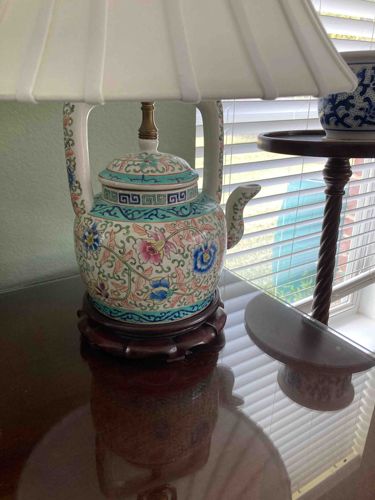
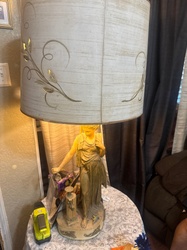
This item is a decorative table lamp featuring a porcelain teapot as its base, mounted on a carved wooden stand. The main body of the teapot is predominantly off-white or cream-colored, adorned with intricate, colorful floral and butterfly motifs in a 'famille rose' or similar palette, utilizing hues of pink, blue, green, and yellow. The lid of the teapot and the neck feature a stylized geometric border (possibly leiwen or similar fretwork) in a light blue-green and dark blue, with additional floral elements on the lid. The teapot's handle and spout are also decorated with coordinating floral patterns. A brass-toned fixture extends upwards from the center of the teapot's lid, supporting a white, pleated fabric lampshade. The lamp base is a dark brown, possibly mahogany or rosewood, intricately carved wooden stand, which adds to the traditional Asian aesthetic. The overall condition appears good, with no immediately visible chips, cracks, or significant wear, though a closer inspection would be needed to confirm. The metal components show a slight patina consistent with age. This lamp appears to be a decorative item, likely intended for ambient lighting, showcasing fine porcelain craftsmanship. The style suggests it could be mid-20th century or later, drawing inspiration from classical Chinese porcelain designs. The quality of the hand-painted details indicates a certain level of craftsmanship, though without a visible maker's mark, specific origin or dating is difficult. The lamp combines functional lighting with an ornamental art object.
AI Appraisal Report
Based on my visual examination of the provided image, this Chinese Porcelain Teapot Table Lamp appears to be in good overall condition. The porcelain body shows no immediate signs of chips, cracks, or significant wear. The intricate 'famille rose' style floral and butterfly motifs are vibrant and well-preserved. The carved wooden stand also appears intact, supporting the traditional aesthetic. The brass-toned fixture has a slight patina, consistent with age, which is generally acceptable for vintage decorative items.
Authenticity, based solely on visual inspection, is challenging. While the craftsmanship of the hand-painted details suggests quality, without a visible maker's mark or more detailed close-up views of the painting technique, confirming its specific origin, age, or artist is impossible. The style is reflective of mid-20th century or later Chinese porcelain reproductions or elaborations on classical designs, rather than a definitively antique piece.
The market for decorative table lamps with Asian-inspired porcelain bases is stable. Comparables typically range from $150 for good quality modern examples to $500+ for older, high-quality, or attributed pieces. Demand is moderate, appealing to collectors of chinoiserie or those furnishing traditional interiors. Rarity is not a significant factor here; while unique in its specific decoration, similar lamps are not uncommon.
Factors significantly impacting value include the quality of the porcelain, the intricacy and artistry of the hand-painting, the condition of both the porcelain and the wooden base, and the overall functionality of the lamp. The current appraisal range reflects the decorative appeal and apparent good condition, coupled with the uncertainty regarding its age and specific attribution.
Limitations in authenticity verification are considerable without a physical examination. I would need to inspect the porcelain for manufacturing techniques, examine the quality of the glaze, look for any unseen repairs, and search for hidden maker's marks or signatures. Scientific testing, such as thermoluminescence dating, would be required to definitively confirm its age. Provenance documentation, if available, would significantly enhance its value.