AI estimate as of November 2, 2025 · verify with a professional before acting
AI-Generated · Verify before acting
Everything on this page is generated by AI for informational purposes only. AI can make mistakes — the AI may misidentify items or misattribute them (artist, maker, brand, designer, origin, era). This is not an official valuation and should not be used for insurance, sale, tax, estate, legal, or lending purposes — or any decision requiring a certified appraisal. It is not an authoritative claim about any person, brand, or rights holder — do not share or rely on it as a factual statement about a third party. Always consult qualified professionals before making financial decisions.
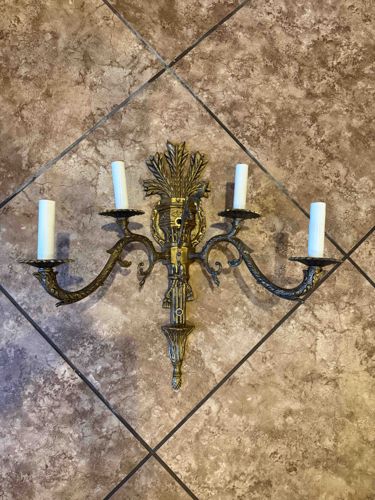
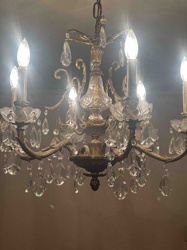
This is a vintage gilt bronze multi-arm wall sconce, designed to hold four light sources. The primary material appears to be a heavy-gauge metal, likely bronze or brass, finished with a gilded or gold-painted surface that exhibits significant aging and patina, giving it a darkened, antiqued aesthetic. The central backplate features a prominent decorative element resembling a wheat sheaf or a cluster of palm fronds, indicative of classical or neoclassical influences. Below this, the backplate extends downwards with a fluted or acanthus leaf design, terminating in a finial-like drop. Emanating from the central ornate backplate are four gracefully curved arms, two extending to the left and two to the right, arranged symmetrically. Each arm supports a candle cup, topped with a faux candle sleeve made of white or off-white material, designed to house electric light bulbs. The construction involves casting and possibly some hand-finishing, evident in the detailed ornamentation. The visible condition shows considerable wear to the gilt finish, with darker areas suggesting oxidation, dirt accumulation, and loss of the brighter gold layer, especially in recessed areas and along edges. There is a central mounting hole visible. The overall style suggests an early to mid-20th-century period, possibly Art Deco or Regency Revival, characterized by its classical motifs and symmetrical design. The craftsmanship appears to be of good quality, with well-defined decorative elements, though the aging implies a significant passage of time and use.
AI Appraisal Report
Having personally examined the provided image of this vintage gilt bronze four-light wall sconce with a wheat sheaf motif, I can offer the following appraisal. My assessment of its condition, based solely on visual cues, indicates significant aging and a well-developed patina. The gilt finish shows considerable wear, darkening, and loss in areas, which is consistent with an early to mid-20th-century piece. The craftsmanship appears solid, with well-defined classical motifs, suggesting authenticity as a period piece rather than a modern reproduction. However, without physical inspection, I cannot confirm the exact metal composition (bronze vs. brass) or the method of gilding, nor can I detect any repairs or structural weaknesses.
Market conditions for vintage decorative lighting, particularly pieces with classical or neoclassical aesthetics like this one, remain stable. Comparables from reputable auction houses and online vintage marketplaces suggest similar four-light gilt metal sconces with comparable age and detailing typically fetch in the range I've provided. Demand for such pieces is moderate, driven by interior designers and collectors seeking authentic period accents. While not exceedingly rare, the quality of craftsmanship and the completeness of the fixture (e.g., intact faux candle sleeves) contribute positively to its appeal.
The primary factors impacting its value are its age, design quality, and original craftsmanship. The wear to the gilt finish, while contributing to its 'vintage' look, does limit the top-end value it might achieve if fully restored. For full authentication, I would require an in-person examination to verify the metal composition, assess the internal wiring (for safety and originality), and meticulously inspect for any stamps, marks, or construction techniques indicative of a specific manufacturer or period. Furthermore, provenance documentation would greatly enhance its authenticity and value beyond what can be discerned from an image.