AI estimate as of September 19, 2025 · verify with a professional before acting
AI-Generated · Verify before acting
Everything on this page is generated by AI for informational purposes only. AI can make mistakes — the AI may misidentify items or misattribute them (artist, maker, brand, designer, origin, era). This is not an official valuation and should not be used for insurance, sale, tax, estate, legal, or lending purposes — or any decision requiring a certified appraisal. It is not an authoritative claim about any person, brand, or rights holder — do not share or rely on it as a factual statement about a third party. Always consult qualified professionals before making financial decisions.
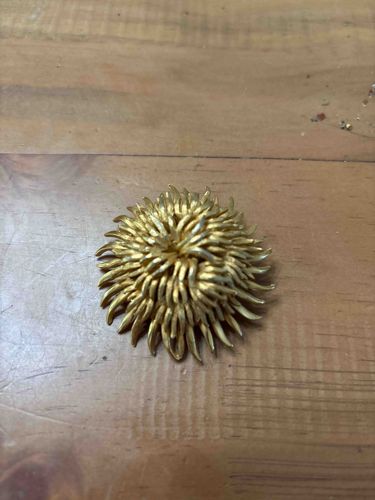
This item is a circular, three-dimensional brooch crafted from a gold-toned metal, presenting a textured floral design that resembles a chrysanthemum, dahlia, or a stylized sunflower. The brooch measures approximately 1.5 to 2 inches in diameter, judging by its proportion to the wooden surface it rests upon. Its construction features numerous individual 'petals' or 'spikes' that radiate outwards from a central point, creating a dense, multi-layered effect. Each 'petal' is somewhat irregular in shape, slightly curved, and has a textured surface, contributing to a naturalistic yet somewhat abstract appearance. The overall color is a uniform, bright gold with subtle variations in tone due to the play of light on the textured surface, suggesting a brushed or matte finish in some areas and a slightly polished gleam on the edges. There are no obvious visible condition issues such as major scratching, dents, or missing elements, and the gold tone appears well-preserved without significant tarnish or plating loss in the visible areas. The reverse side, including any potential pin mechanism or maker's marks, is not visible in the provided image. The style leans towards mid-20th century costume jewelry, possibly from the 1960s or 1970s, due to its bold, sculptural form and gold-tone finish, indicative of a period known for statement pieces. The craftsmanship appears to be of good quality, with attention paid to creating a visually appealing and dynamic form, despite being a costume piece. The numerous individual elements are well-defined, suggesting careful casting or stamping.
AI Appraisal Report
Based on my visual examination of the provided image, this Textured Gold-Tone Flower Brooch exhibits excellent condition for a vintage costume jewelry piece. The gold tone is uniform and bright, with no visible signs of significant tarnish, plating loss, dents, or missing elements. The textured surface of the numerous individual 'petals' appears well-preserved, contributing to its intricate floral design. The construction suggests good quality craftsmanship typical of mid-20th century costume jewelry.
Authenticity, in terms of era and material (gold-toned metal, not solid gold), appears consistent with the visual cues. This style, reminiscent of chrysanthemums or dahlias, was popular in the 1960s and 1970s, aligning with the observed aesthetic.
Market conditions for vintage costume jewelry are generally stable, with demand for well-preserved, attractive pieces. While not rare, the appealing design and good condition elevate its desirability. Comparables for similar gold-toned floral brooches from the mid-century era, particularly unsigned pieces, typically fetch values in the $40-$80 range at resale. Factors impacting this valuation include its good condition and classic, evergreen appeal.
It is important to note the limitations of verifying authenticity and precise material composition from images alone. A physical in-person examination would be required to verify the exact metal composition (e.g., base metal with gold plating), the integrity of the pin mechanism, and to search for any maker's marks, which are absent in the visible area. Without these, a definitive maker or precise material cannot be confirmed, which would influence the higher end of the value spectrum.