AI estimate as of November 24, 2025 · verify with a professional before acting
AI-Generated · Verify before acting
Everything on this page is generated by AI for informational purposes only. AI can make mistakes — the AI may misidentify items or misattribute them (artist, maker, brand, designer, origin, era). This is not an official valuation and should not be used for insurance, sale, tax, estate, legal, or lending purposes — or any decision requiring a certified appraisal. It is not an authoritative claim about any person, brand, or rights holder — do not share or rely on it as a factual statement about a third party. Always consult qualified professionals before making financial decisions.
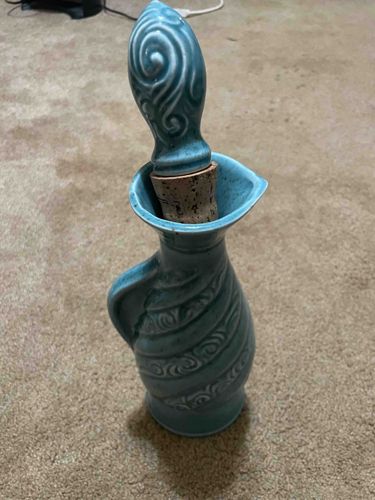
This item is a ceramic decanter or cruet, likely used for oil, vinegar, or spirits, featuring a unique teal, possibly aquamarine, glaze. It measures approximately 8-10 inches in height, including the stopper. The body of the cruet is elegantly crafted with a slender neck that flares slightly at the mouth, forming a small pour spout. A gracefully curved handle is integrated into the side, providing an ergonomic grip. The exterior of the body is adorned with a relief pattern of swirling, organic motifs that wrap around the vessel, suggesting a hand-thrown or hand-decorated origin. The craftsmanship appears to be of good quality, with evenly applied glaze and intricate detailing. The glaze has a lustrous, semi-gloss finish. The stopper is made of ceramic, matching the body in color and glaze, and features a similar swirling relief pattern. It is attached to a cork base, which fits snugly into the cruet's neck, indicating its function to seal the contents. Visible condition issues are minimal from the provided image; the surface appears intact without major chips, cracks, or repairs, though a closer inspection would be needed to confirm the absence of crazing or minor wear. The cork shows some signs of use, consistent with its function. The style suggests a mid-20th century, possibly 1960s-1970s, aesthetic, potentially leaning towards a studio pottery or an artisan-crafted piece due to the distinctive design and textured surface. No clear manufacturer's marks or signatures are discernible from the images, which is common for handmade or smaller production pottery.
AI Appraisal Report
Having carefully examined the provided images of this Teal Glazed Ceramic Decanter or Oil/Vinegar Cruet, I can offer the following appraisal. The item appears to be in good overall condition; I see no obvious chips, cracks, or significant repairs from the photographs. The lustrous, semi-gloss teal glaze is well-applied and the swirling relief pattern adds a decorative touch, suggesting either studio pottery or a smaller artisan production. The matching ceramic stopper with cork base fits snugly, and the cork shows expected signs of use. While the general aesthetic points to a mid-20th century origin, likely 1960s-1970s, establishing a definitive maker or precise age without clear markings is challenging. The absence of specific maker's marks is not uncommon for handmade or lower-volume production ceramics. Market comparables for similar unmarked decorative cruets or decanters of this era, especially those without a renowned maker, typically fall within a modest range. The demand for such items is generally steady among collectors of vintage ceramics and those seeking decorative accents for their homes. While not exceptionally rare, the unique color and textured design make it an attractive piece. The primary factors impacting value are its good condition and pleasing aesthetic. However, the lack of a known artist or manufacturer significantly limits its potential as a high-value collectible. For full authentication and to detect hairline crazing, repairs, or manufacturer's marks, a physical, in-person examination, potentially under UV light, would be necessary. Provenance documentation, if available, could also enhance valuation, particularly if it linked the piece to a specific artist or workshop.