AI Appraisal Estimate

AI-generated estimates · not official valuations

From the user

What was submitted

Photo and notes provided by the user — not generated by AI

Submitted item photo
Submitted photo · June 20, 2026

User's notes

Chair

AI analysis below

AI appraisal

AI analysis & estimate

AI-Generated · Verify before acting

Everything below is generated by AI for informational purposes only. AI can make mistakes — the AI may misidentify items or misattribute them (artist, maker, brand, designer, origin, era). This is not an official valuation and should not be used for insurance, sale, tax, estate, legal, or lending purposes — or any decision requiring a certified appraisal. It is not an authoritative claim about any person, brand, or rights holder — do not share or rely on it as a factual statement about a third party. Always consult qualified professionals before making financial decisions.

Note

This analysis also relies on unverified notes provided by the user, which may be incomplete or inaccurate and could affect the result.

Read the full disclaimer

AI Identification

·Not independently authenticated·Verify before acting

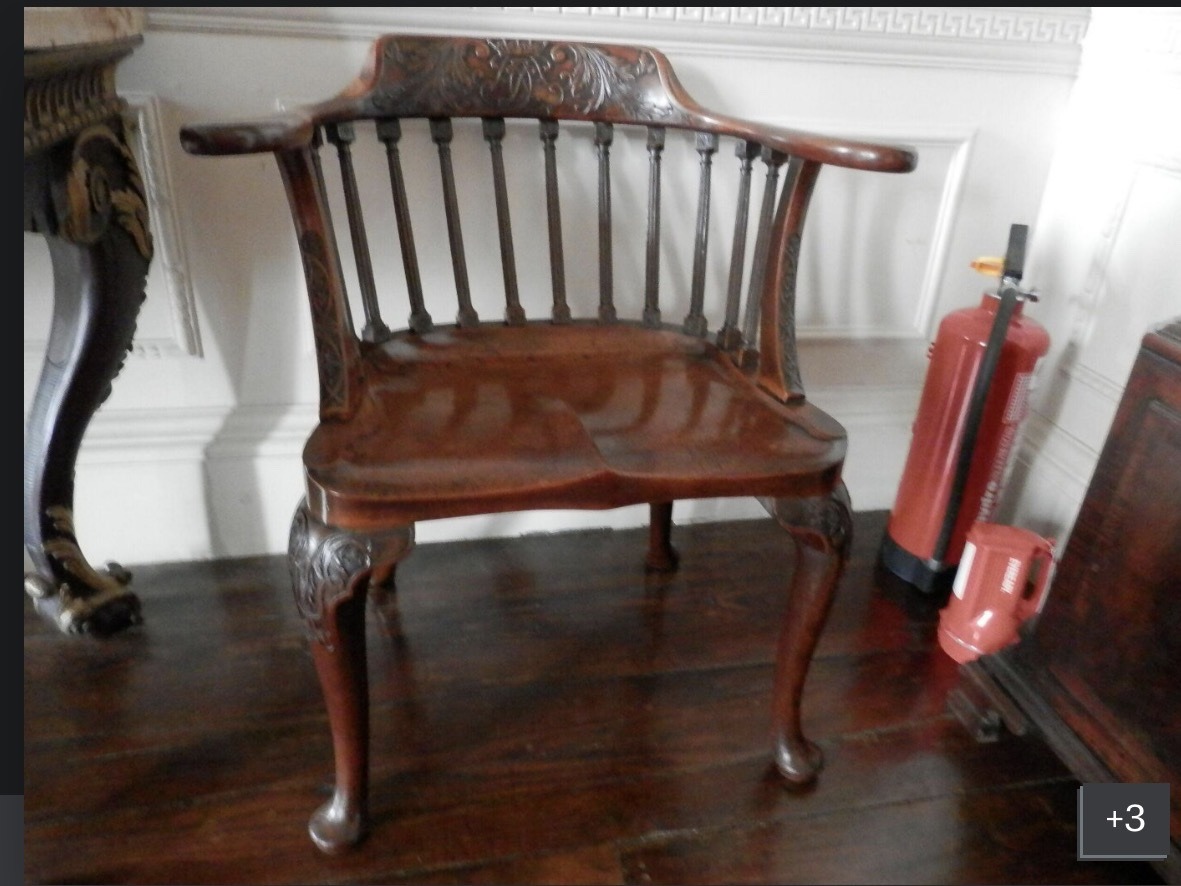
George II-style carved mahogany armchair

Antique Furniture

AI Estimated Value

·Not an official valuation·Verify before acting

$1,200 - $2,500

As of June 20, 2026

AI Item Analysis

·AI can make mistakes·Verify before acting
This armchair is stylistically consistent with English George II-era furniture, characterized by its low-back 'captain' or 'desk chair' silhouette. The piece is constructed from a dark-stained wood, appearing consistent with mahogany, and features a horseshoe-shaped backrest supported by a series of vertical, turned spindles. A central splat or crest rail displays ornate foliate and scroll carvings. The solid seat is shaped with a saddle-style contour and front-center projection. Notably, the chair stands on four cabriole legs; the two front legs are heavily decorated with acanthus leaf carvings at the knees and terminate in pad feet. The wood surface shows a high-gloss finish, possibly a later lacquer or polish, with some visible wear consistent with age, including softening of the carved details and minor scuffs along the seat edges. No maker's marks or stamps are visible in the image, and the owner-supplied identification of 'Chair' is too generic to provide specific provenance. Consequently, this identification remains a stylistic hypothesis subject to in-person inspection of the joinery and timber to distinguish a 18th-century example from a high-quality late 19th-century revivalist reproduction.
AI Appraisal Report

·AI can make mistakes·Verify before acting
Based on the provided imagery, I have evaluated this George II-style carved mahogany armchair. From what I can see, the piece exhibits many stylistic hallmarks of the mid-18th century, including the horseshoe back, turned spindles, and foliate-carved cabriole legs. However, I cannot verify from a photo whether this is an 18th-century period piece or a high-quality late 19th-century Centennial-era reproduction. The high-gloss finish and the 'softness' of the carving suggest it may have been refinished or could be a later revivalist example. The value estimate of $1,200 - $2,500 is based on the hypothesis that the piece is a high-quality historical reproduction in good condition. If the armchair is found to be a period-correct 18th-century example through an in-person inspection of the joinery and timber, the value could increase significantly, potentially exceeding $5,000. Conversely, if it is a modern 20th-century mass-produced 'in the style of' chair, the value would likely fall below $400. To confirm its true nature, a physical examination of the underside and grain is necessary, as I cannot determine the specific age of the wood or the presence of hand-tool marks from these images. Market demand for George II revival furniture remains steady for interior design purposes, though collectors pay a substantial premium for provenance and period-correct construction. Achieving the higher end of the estimate would require documentation of its history or an expert physical appraisal to differentiate it from more common later copies.

Get your items appraised

Instant estimates of your treasures with AI-powered appraisals

Browse More Appraisals