AI estimate as of July 8, 2025 · verify with a professional before acting
AI-Generated · Verify before acting
Everything on this page is generated by AI for informational purposes only. AI can make mistakes — the AI may misidentify items or misattribute them (artist, maker, brand, designer, origin, era). This is not an official valuation and should not be used for insurance, sale, tax, estate, legal, or lending purposes — or any decision requiring a certified appraisal. It is not an authoritative claim about any person, brand, or rights holder — do not share or rely on it as a factual statement about a third party. Always consult qualified professionals before making financial decisions.
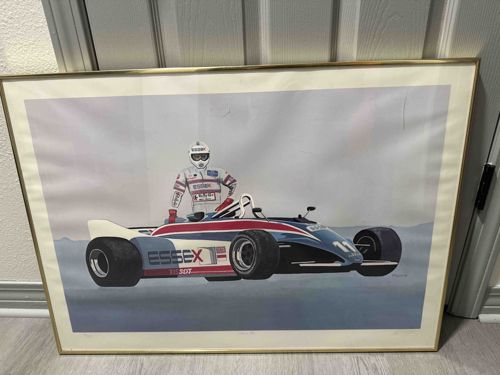
This is a framed art print depicting a Formula 1 racing scene. The print features a detailed rendering of a driver in a white racing suit and helmet standing beside a vintage-style Formula 1 race car. The car is prominently branded with 'ESSEX' in large red letters on a white and blue striped side panel, alongside smaller '337SDT' text. It also shows a number '11' on the nose cone. The color palette of the print primarily consists of muted blues, grays, and whites for the background, providing a sense of speed or horizon, contrasting with the vibrant red and blue accents on the car and driver's suit. The print is housed within a simple, narrow, gold-toned metal frame, which appears to be in good condition with minor signs of wear consistent with age, such as potential scuffs or oxidation. The print itself exhibits some minor condition issues, including visible vertical lines or scratches on the upper left-hand side, suggesting wear to the print surface or possibly the protective glazing. The print image quality and detail suggest it could be a lithograph or offset print. There are no discernible maker's marks or signatures visible in the provided image; however, the aesthetic style points to the late 20th century, likely the 1970s or early 1980s, given the car design and Essex sponsorship, which was active in Formula 1 during that period. The overall craftsmanship of the print appears competent, capturing the details of the racing vehicle and driver accurately. The print has a clean, somewhat minimalist composition, focusing on the main subjects. Its size appears to be substantial, likely occupying a significant wall space.
AI Appraisal Report
Upon examining the image of this Vintage Formula 1 'Essex' Racing Car Art Print, I've assessed its condition and potential value. The print itself appears to be a lithograph or offset print, given its detail and lack of visible brushstrokes, suggesting mass production rather than an original artwork. Condition-wise, the gold-toned metal frame shows minor wear consistent with age, likely scuffs or oxidation. The print, however, exhibits visible vertical lines or scratches on the upper left, which could be on the print surface itself or the protective glazing, impacting its aesthetic appeal. I cannot definitively determine from the image if this damage is superficial to the glazing or if it affects the print medium underneath.
The aesthetic style, the prominent 'ESSEX' branding (active in F1 in the late 1970s/early 1980s), and the vintage car design strongly suggest an origin from that period. Without a visible signature or maker's mark, confirming the artist or publisher is impossible from the image alone.
In terms of market conditions, vintage racing art prints, especially those depicting iconic eras or sponsors, have a niche but consistent demand among motorsports enthusiasts and collectors of automobilia. Comparables for unsigned, mass-produced prints of this era typically range from affordable to moderately priced. The lack of an identifiable artist or limited edition status prevents it from commanding higher values. Rarity is difficult to ascertain without production numbers, but such prints were often produced in significant quantities. The condition issues, particularly the scratches, negatively impact its value, as collectors generally prefer pristine examples.
For full authentication and to determine if it's part of a known series or by a notable artist (thus impacting value significantly), an in-person examination would be crucial. This would allow for a closer inspection of the print medium, potential hidden signatures, and the exact nature of the damage. Provenance documentation, if available, such as original purchase receipts or exhibition history, would also greatly aid in authentication and valuation. Without these, my appraisal is based solely on visual cues from the image.