AI Appraisal Estimate

AI-generated estimates · not official valuations

From the user

What was submitted

Photo and notes provided by the user — not generated by AI

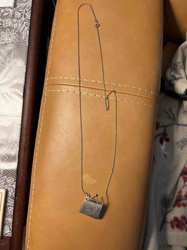
Submitted item photo
Submitted photo · May 16, 2026

User's notes

No additional notes provided.

AI analysis below

AI appraisal

AI analysis & estimate

AI-Generated · Verify before acting

Everything below is generated by AI for informational purposes only. AI can make mistakes — the AI may misidentify items or misattribute them (artist, maker, brand, designer, origin, era). This is not an official valuation and should not be used for insurance, sale, tax, estate, legal, or lending purposes — or any decision requiring a certified appraisal. It is not an authoritative claim about any person, brand, or rights holder — do not share or rely on it as a factual statement about a third party. Always consult qualified professionals before making financial decisions.

Read the full disclaimer

AI Identification

·Not independently authenticated·Verify before acting

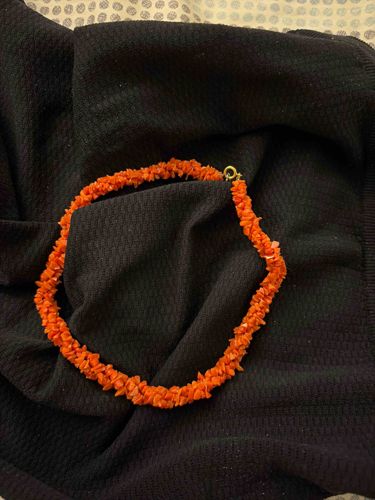
Vintage Multi-Strand Red Coral Chip Necklace

Vintage Fine & Costume Jewelry

AI Estimated Value

·Not an official valuation·Verify before acting

$125 - $225

As of May 16, 2026

AI Item Analysis

·AI can make mistakes·Verify before acting
This item is a vintage-style, multi-strand twisted necklace composed of vibrant red coral chips. The coral pieces are irregularly shaped and vary slightly in size, typical of 'chip' or 'nugget' jewelry, giving the piece a rich, organic texture. The color is a distinct, saturated reddish-orange, likely indicating Mediterranean or bamboo coral. The strands are tightly twisted together to create a chunky, rope-like aesthetic. The necklace is secured with a small brass or gold-toned metal spring ring clasp. The overall length appears to be of 'collar' or 'choker' style, likely measuring between 14 to 16 inches. Regarding condition, the coral chips appear to be well-maintained with a natural matte-to-slight-gloss finish, though some surface pitting inherent to natural coral is visible upon close inspection. The stringing material is not clearly visible but seems intact, holding the tension of the twist well. There is no significant evidence of broken chips or lost strands. The metal clasp shows minor signs of oxidation consistent with age, suggesting it may be a vintage piece from the mid-to-late 20th century (circa 1960s-1980s). The craftsmanship is characteristic of artisan or souvenir jewelry popular during that era. It lacks visible maker's marks or hallmarks on the clasp, which is common for this type of organic gemstone jewelry.
AI Appraisal Report

·AI can make mistakes·Verify before acting
Upon visual examination of this multi-strand twisted coral chip necklace, I find it to be a classic example of Mediterranean or Dyed Bamboo coral jewelry, likely dating to the 1970s or 1980s. The saturated reddish-orange hue and organic 'chip' morphology are characteristic of the 'Bohemian' style popularized during that era. The strands appear well-tensioned, and the natural pitting observed is consistent with authentic coral rather than synthetic glass or plastic imitations. The use of a simple base-metal spring ring clasp suggests this was marketed as high-quality costume or artisanal souvenir jewelry rather than fine jewelry set in precious metals. The market for vintage coral remains steady; however, chip-style jewelry is more common and less valuable than uniform round beads or carved cabochons. Current market comparables for multi-strand untreated coral necklaces of this length typically fall within the $100 to $250 range at auction or vintage retail. The absence of a designer hallmark or precious metal content limits its upper-end ceiling. Critically, this appraisal is based solely on high-resolution imagery. Without a physical inspection, I cannot definitively distinguish between Mediterranean coral (Corallium rubrum) and dyed Bamboo coral, the latter of which would significantly lower the value. Furthermore, I cannot verify if the color has been enhanced with dyes, which is common for this material. A full authentication would require a 'hot needle' test to check for wax/dye treatment and a microscopic inspection of the 'fingerprint' grain patterns. Provenance documentation or an original purchase receipt would further validate its age and origin.

Get your items appraised

Instant estimates of your treasures with AI-powered appraisals

Browse More Appraisals