These notes were written by the person who submitted this item. Appraiser.AI has not verified them, and the AI's identification and estimate may rely on them.
AI Estimated Value
Not an official valuation
$300-500
AI estimate as of September 26, 2025 · verify with a professional before acting
AI-Generated · Verify before acting
Everything on this page is generated by AI for informational purposes only. AI can make mistakes — the AI may misidentify items or misattribute them (artist, maker, brand, designer, origin, era). This is not an official valuation and should not be used for insurance, sale, tax, estate, legal, or lending purposes — or any decision requiring a certified appraisal. It is not an authoritative claim about any person, brand, or rights holder — do not share or rely on it as a factual statement about a third party. Always consult qualified professionals before making financial decisions.
This analysis also relies on unverified notes provided by the user, which may be incomplete or inaccurate and could affect the result.
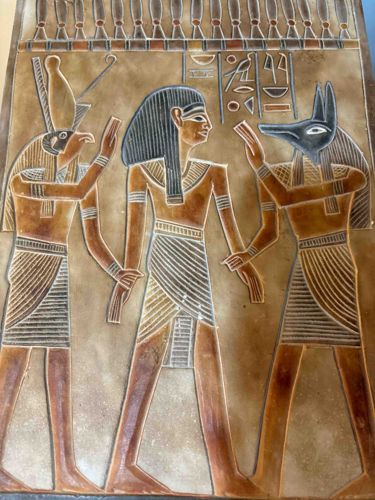
This item is an ancient Egyptian style carved stone relief, depicting three figures in profile. The central figure appears to be a pharaoh or royal personage, characterized by the nemes headdress with a uraeus (cobra) at the front, a striped kilt, and armbands. To the left stands the god Horus with his falcon head crowned with a sun disk and uraeus, and the god Anubis with a jackal head is positioned to the right, presenting an ankh (key of life) to the central figure. The figures have distinct outlines and details carved into what appears to be a light brown or sandy colored stone, possibly limestone or a composite material mimicking it. The recessed areas have been painted in various earthy tones: dark brown for skin, black for hair and some headdresses, white or light gray for garments, and lighter shades for certain details and hieroglyphics. Hieroglyphs are present above the central figure, adding to the authenticity of the ancient Egyptian aesthetic. The carving exhibits a slightly raised (bas-relief) technique, providing depth and shadow. The overall condition appears good with a consistent patination, suggesting either age or an intentional aged finish. There are no immediately obvious signs of severe damage, chips, or repairs, though some minor surface wear and discoloration consistent with age or handling might be present upon closer inspection. The craftsmanship indicates a decorative piece, possibly a wall hanging or tablet, emulating the artistic conventions of ancient Egyptian tomb and temple art. The style is characteristic of New Kingdom period reliefs, although this piece is likely a later reproduction or homage. The detailed carving and coloration suggest a deliberate effort to capture the iconic imagery of Egyptian mythology and royalty.
AI Appraisal Report
I have examined the provided image and description of this Ancient Egyptian Style Stone Relief Carving depicting three deities/figures. The item presents as a well-executed decorative piece, emulating ancient Egyptian tomb and temple art, specifically consistent with New Kingdom period aesthetics. The carving method is a bas-relief technique, showing good detail in the headdresses, garments, and the ankh. The color application, with earthy tones for skin and black for hair, aligns with traditional Egyptian artistic conventions. The presence of hieroglyphics adds to its aesthetic appeal.
From the visual evidence, the condition appears good, with no obvious major chips, cracks, or repairs. The consistent patination suggests either age or an intentional antique finish. The material appears to be limestone or a composite mimicking it.
Based on the craftsmanship and style, this piece is almost certainly a later reproduction or homage rather than an authentic ancient artifact. The clean lines, consistent coloration, and overall 'too perfect' presentation often characterize modern decorative pieces. True ancient artifacts typically exhibit more significant signs of wear, degradation, and unique patinas that are difficult to perfectly replicate.
Market conditions for ancient Egyptian-style reproductions are generally stable, with demand driven by interior decorators and collectors of exotic decor. Comparisons can be made with quality museum reproductions or higher-end tourist art. The value is influenced by its size, quality of craftsmanship, and decorative appeal. While visually striking, its lack of genuine antiquity significantly impacts its market value. Scientific testing of the stone material and pigments, along with a detailed provenance report, would be essential to definitively rule out any remote possibility of true ancient origin.
Therefore, considering it as a high-quality decorative reproduction rather than an authentic ancient artifact, I would place its appraisal value in the range of $300-500. This valuation reflects its aesthetic appeal, good condition, and quality of execution as a decorative object.