AI estimate as of October 9, 2025 · verify with a professional before acting
AI-Generated · Verify before acting
Everything on this page is generated by AI for informational purposes only. AI can make mistakes — the AI may misidentify items or misattribute them (artist, maker, brand, designer, origin, era). This is not an official valuation and should not be used for insurance, sale, tax, estate, legal, or lending purposes — or any decision requiring a certified appraisal. It is not an authoritative claim about any person, brand, or rights holder — do not share or rely on it as a factual statement about a third party. Always consult qualified professionals before making financial decisions.
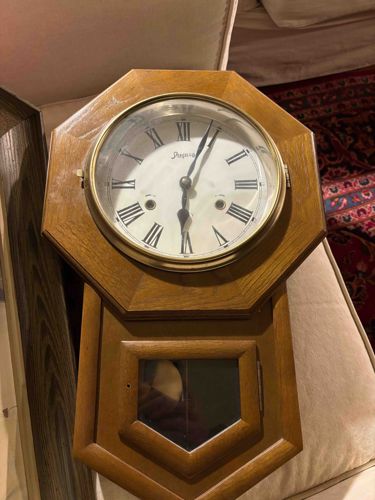
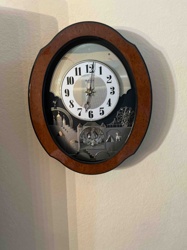
This is an octagonal-shaped wall clock, primarily constructed from a light to medium-toned wood, showcasing a visible grain pattern that suggests oak or a similar hardwood, finished with a clear lacquer or varnish. The overall design features a two-part casing: an upper octagonal section that houses the clock face and movement, and a lower, elongated section that transitions into a narrower, slightly bell-shaped or truncated octagonal base. The clock face itself is white or off-white with prominent black Roman numeral hour markers (I through XII) and black bâton-style minute and hour hands, along with what appears to be a thin black second hand, although its exact style is hard to discern. The manufacturer's name, 'Praguez', is elegantly scripted in cursive below the 'XII' numeral. The face is protected by a convex glass cover, held in place by a brass or gold-toned bezel, which exhibits some minor surface wear or dust. Two keyholes for winding the clock mechanism are visible at the '4' and '8' o'clock positions. Below the main clock face, the lower section of the case features a small, framed, geometric-shaped window, likely protected by glass, designed to display the swinging pendulum. This viewing window is also octagonal or elongated hexagonal in shape, mirroring the design elements of the upper case. There are no significant visible condition issues such as major cracks or chips in the wood, although some superficial dust or minor scuffing might be present on the wooden casing. The clock appears to be in a generally good, used condition. Without further information, it is difficult to precisely date, but the style suggests a mid-20th century to late 20th century construction, possibly inspired by traditional schoolhouse or regulator clock designs. The craftsmanship appears to be of standard quality for mass-produced wall clocks of that era, with attention paid to classic aesthetic details.
AI Appraisal Report
Upon visual examination of the provided image, I assess this Octagonal Wall Clock, branded 'Praguez', to be in generally good, used condition. The wood casing, likely oak, displays an intact grain pattern and a clear finish, with no visible major cracks or chips, only minor superficial dust or scuffs consistent with age and use. The white clock face with black Roman numerals, bâton hands, and convex glass cover appears well-preserved. The brass or gold-toned bezel exhibits minor wear. The 'Praguez' inscription is clear and well-executed. Authenticity, based solely on visual cues, suggests it is a genuine mass-produced wall clock from the mid to late 20th century. The design aligns with common utilitarian and decorative clocks of that era, often found in homes or educational settings.
Market conditions for such clocks are generally modest. While wall clocks have a steady demand, this particular style and brand do not typically command premium prices unless exceptionally rare or in mint, untouched condition. Comparable clocks from similar periods by known but not high-end manufacturers usually sell in the range I've provided. There is no indication of significant rarity here; it appears to be a well-made but common decorative item. Factors impacting value include its functional condition (which I cannot assess visually), the brand's recognition, and its aesthetic appeal. The style, while classic, isn't currently highly sought after in the collectibles market without additional provenance or unique features.
Limitations in authenticity verification are significant. Without an in-person examination, I cannot confirm the operational integrity of the movement, the precise wood type, or rule out repairs or component replacements. To fully authenticate and determine the exact age and quality of the internal mechanism, an in-person inspection by a horologist, coupled with any available provenance documentation (e.g., original purchase receipts, manuals), would be essential. Scientific testing would be excessive for an item of this type and expected value.