AI estimate as of August 31, 2025 · verify with a professional before acting
AI-Generated · Verify before acting
Everything on this page is generated by AI for informational purposes only. AI can make mistakes — the AI may misidentify items or misattribute them (artist, maker, brand, designer, origin, era). This is not an official valuation and should not be used for insurance, sale, tax, estate, legal, or lending purposes — or any decision requiring a certified appraisal. It is not an authoritative claim about any person, brand, or rights holder — do not share or rely on it as a factual statement about a third party. Always consult qualified professionals before making financial decisions.
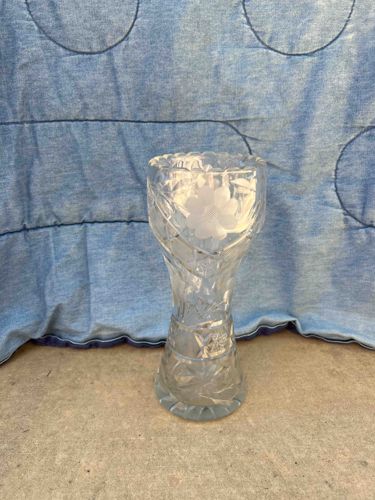
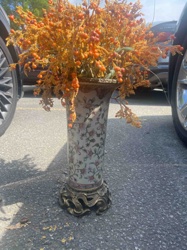
This is a clear glass vase, likely made of pressed or cut crystal, given its intricate patterns and faceted surfaces. The vase has a flared mouth with a scalloped or undulating rim, and its body tapers slightly inward before flaring out again towards the base, creating an hourglass or trumpet-like silhouette characteristic of decorative flower vases. The most prominent feature is the detailed pattern work. The upper section of the vase exhibits deep diagonal cuts that create a sense of movement and catch the light, interspersed with what appears to be frosted or etched floral motifs. Below this, there are sections with more geometric patterns, including diamond cuts and starburst designs, which extend down to the wider base. The base itself is also heavily patterned, suggesting a sturdy and decorative foundation. The clear glass allows light to refract, highlighting the various cuts. While no significant visible damage like chips or cracks are apparent from the image, the overall condition appears good with potential for minor signs of age or use consistent with a vintage item, such as slight surface scratches or water residue (patina) that is common with used glass items. The craftsmanship appears to be of decent quality, characterized by uniform cuts and clear glass. Without specific maker's marks, determining the precise age is difficult, but the style suggests it could be mid-20th century, possibly dating from the 1950s to 1980s, reflecting a traditional or classic design aesthetic often seen in decorative glassware.
AI Appraisal Report
Based on my visual examination of the provided image, this clear pressed or cut glass vase appears to be in good overall condition. I observe no visible chips or cracks, although minor surface scratches or water residue, common with age and use, are likely but cannot be definitively confirmed without physical inspection. The detailed floral and geometric patterns suggest it's either pressed glass made to mimic cut crystal or true cut glass. The craftsmanship appears consistent with decorative glassware from the mid-20th century, likely between the 1950s and 1980s.
In the current market, vases of this style are generally plentiful. Comparable items, often found in antique shops, online marketplaces, or estate sales, typically range from $30 to $100 depending on complexity, size, and actual material composition (pressed vs. cut). There is a steady but not exceptionally high demand for such decorative glass vases, as they are not rare. Factors impacting value include the actual manufacturing method (true cut crystal would fetch more than pressed glass), the presence of any maker's marks which would increase authenticity and appeal to collectors, and the overall quality of the glass and cuts. Without such marks, it's considered generic decorative glassware.
My primary limitation in authenticity verification from an image alone is differentiating between genuine cut crystal and pressed glass. An in-person examination would allow me to feel the sharpness of the cuts, assess the weight, and inspect the specific clarity and brilliance of the glass. Furthermore, a physical inspection could reveal any faint maker's marks, micro-surface imperfections, or evidence of repair that are not discernible in a photograph. Provenance documentation, if available, would also be crucial for any higher authentication or historical context, but is not expected for an item of this type and value range. Scientific testing is not typically warranted for an item of this nature.