AI estimate as of August 13, 2025 · verify with a professional before acting
AI-Generated · Verify before acting
Everything on this page is generated by AI for informational purposes only. AI can make mistakes — the AI may misidentify items or misattribute them (artist, maker, brand, designer, origin, era). This is not an official valuation and should not be used for insurance, sale, tax, estate, legal, or lending purposes — or any decision requiring a certified appraisal. It is not an authoritative claim about any person, brand, or rights holder — do not share or rely on it as a factual statement about a third party. Always consult qualified professionals before making financial decisions.
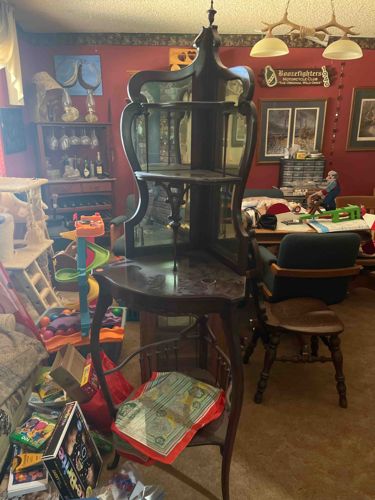
This is a tall, ornate wooden corner display cabinet, likely dating from the late 19th to early 20th century, possibly in the Victorian or Edwardian style given its decorative elements. It appears to be constructed from a dark-stained hardwood, possibly mahogany or walnut, exhibiting a rich, deep brown finish. The cabinet is designed to fit into a corner, indicated by its triangular base and back, efficiently utilizing space.
The upper section features carved flourishes and a pointed finial at its apex, adding to its grand appearance. There are multiple interior shelves, at least two visible, which are likely intended for displaying decorative objects. The sides of the upper display section are enclosed with glass panels, allowing visibility of the contents from various angles, which would have been a hallmark of display cabinetry. The glass appears to be flat and intact, though reflections make it difficult to ascertain clarity or any beveling. The wooden framework forming the display area has decorative cutouts and curves, characteristic of period furniture.
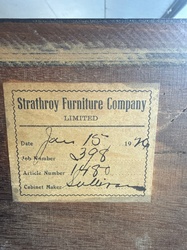
The lower section of the cabinet transitions from the display top to a more open, stand-like base. It features elegant, turned or carved legs, possibly four in total, supporting the main structure. Below the primary top surface, there is another small, open shelf or platform, suggesting additional storage or display space. The overall condition appears to show some signs of wear consistent with its age, such as potential scratches, minor finish loss, or dust accumulation on its surfaces. However, no major structural damage or repairs are immediately evident from the image. The craftsmanship suggests a manufactured piece, perhaps from a known furniture maker, though no specific maker's marks are discernible. The design emphasizes both functionality and aesthetic appeal, typical of display pieces from its era.
AI Appraisal Report
Upon examining the provided image of this Victorian/Edwardian Corner Display Cabinet, I assess its condition as good, commensurate with its age. I see no immediate signs of major structural damage or repairs, although typical wear such as minor scratches, finish loss, and dust accumulation are evident, which is expected for a piece from the late 19th or early 20th century. The ornate carvings, turned legs, and glass panels appear intact, suggesting a well-cared-for item.
Authenticity, based purely on visual examination, appears high. The design elements—dark-stained hardwood (likely mahogany or walnut), decorative flourishes, pointed finial, and multi-tiered display—are entirely consistent with the Victorian or Edwardian periods. The craftsmanship indicates a manufactured piece, characteristic of that era.
The current market for antique furniture, particularly pieces of this specific style, is generally stable but not experiencing significant surges. Corner display cabinets, while functional, have a slightly narrower appeal than more versatile pieces. Comparables on the market for similar era and condition range broadly, but this piece's apparent quality places it above entry-level items. Demand for such specific display pieces is moderate; collectors or individuals outfitting period homes would be the primary interested parties. Rarity is moderate; while not unique, such well-preserved examples are not commonplace. Factors impacting value include the good overall condition, apparent original finish, and classic design. The choice of wood (mahogany would be more desirable than walnut, and both more so than oak) can also slightly influence value.
It is crucial to note the limitations of authenticity verification from images alone. I cannot definitively confirm wood species, detect subtle repairs under current finishes, or verify the originality of all components (e.g., glass) without in-person examination. For full authentication, I would recommend a physical inspection to assess the joinery, examine the interior for maker's marks or labels, and perform scientific analysis of the wood and finish to confirm age. Testing of the glass for period-appropriate characteristics would also be beneficial.