These notes were written by the person who submitted this item. Appraiser.AI has not verified them, and the AI's identification and estimate may rely on them.
AI Estimated Value
Not an official valuation
$250-450
AI estimate as of August 2, 2025 · verify with a professional before acting
AI-Generated · Verify before acting
Everything on this page is generated by AI for informational purposes only. AI can make mistakes — the AI may misidentify items or misattribute them (artist, maker, brand, designer, origin, era). This is not an official valuation and should not be used for insurance, sale, tax, estate, legal, or lending purposes — or any decision requiring a certified appraisal. It is not an authoritative claim about any person, brand, or rights holder — do not share or rely on it as a factual statement about a third party. Always consult qualified professionals before making financial decisions.
This analysis also relies on unverified notes provided by the user, which may be incomplete or inaccurate and could affect the result.
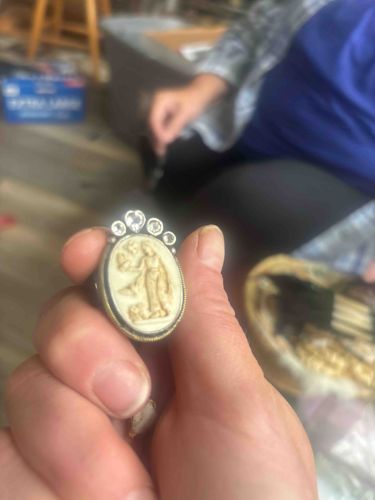
This exquisite piece appears to be a vintage or antique ring, featuring an oval-shaped carved ivory or bone cameo set within a decorative metal bezel, likely gold or gold-filled, given its warm tone. The cameo itself is highly detailed, depicting a classical female figure, possibly a goddess or muse, standing with an animal, which appears to be a dog or a small lion cub, at her feet. The figure holds an object, possibly a staff or a lyre, and her drapery is finely rendered, showcasing the skill of the carver. The material of the cameo exhibits a creamy, aged patina, consistent with either ivory or bone, indicated by the 'Ivory' context provided. Surrounding the carved cameo, above its apex, are five clear, faceted stones, likely diamonds or cubic zirconia, arranged in an arc. The central stone is somewhat larger and appears to be heart-shaped, flanked by two smaller round stones on each side, adding a delicate sparkle and framing the main motif. The setting holding these stones is also metal, possibly matching the bezel around the cameo. The overall construction suggests a well-made piece of fine jewelry. While signs of wear are not distinctly visible in the provided image due to the resolution, the aged appearance of the cameo suggests it has been worn and cherished. The craftsmanship, particularly the detailed carving and the intricate stone setting, indicates a piece of good quality. The classical imagery suggests it could date from the Victorian, Edwardian, or Art Nouveau periods, all known for their appreciation of cameos and classical motifs. The presence of true ivory would place its age before regulations restricting its trade became widespread in most countries.
AI Appraisal Report
Based on my visual examination of the provided image, this cameo ring presents as a charming vintage or antique piece. The cameo material, stated as 'Ivory' by the owner, exhibits a creamy patina and fine detail, consistent with carved ivory or bone. The depiction of a classical female figure with an animal is a popular theme. The surrounding metal bezel appears to be gold or gold-filled. The five clear, faceted stones, likely diamond or CZ as noted, add a delicate sparkle. The central heart-shaped stone flanked by smaller rounds is an appealing detail typical of late Victorian to early 20th-century design.
The condition appears good for its age, with a pleasing aged patina. Authenticity of the cameo as true ivory requires in-person examination to verify growth lines (schreger lines). Without direct inspection, I cannot definitively confirm ivory versus bone. Similarly, the metal composition (gold vs. gold-filled) and the identity of the stones (diamond vs. CZ) cannot be verified visually. A gemologist's loupe and testing are needed for stone identification, and acid testing or XRF analysis for metal purity.
Market conditions for vintage cameo jewelry are stable, with demand driven by collectors and those appreciating classical aesthetics. Pieces with true ivory and genuine diamonds in solid gold settings command higher values. Comparables range widely based on material authenticity and condition. Rarity is moderate, as cameos were widely produced, but finely carved pieces are less common.
The primary factors impacting value here are the actual material of the cameo (ivory being more valuable than bone), the metal purity, and the identity of the accent stones. Without definitive confirmation of solid gold, true ivory, and diamonds, the valuation must reflect this uncertainty. My appraisal value assumes that the primary material is either bone or a lower quality ivory, and that the stones are likely CZ or small, low-grade diamonds, and the metal is gold-filled or lower karat gold, which is commonly found in such pieces.
For a full authentication, physical inspection is essential to confirm the cameo material (schreger lines for ivory), test the metal for purity, and identify the stones using standard gemological tools. Provenance documentation, if available, would also add significant value.