AI estimate as of July 9, 2025 · verify with a professional before acting
AI-Generated · Verify before acting
Everything on this page is generated by AI for informational purposes only. AI can make mistakes — the AI may misidentify items or misattribute them (artist, maker, brand, designer, origin, era). This is not an official valuation and should not be used for insurance, sale, tax, estate, legal, or lending purposes — or any decision requiring a certified appraisal. It is not an authoritative claim about any person, brand, or rights holder — do not share or rely on it as a factual statement about a third party. Always consult qualified professionals before making financial decisions.
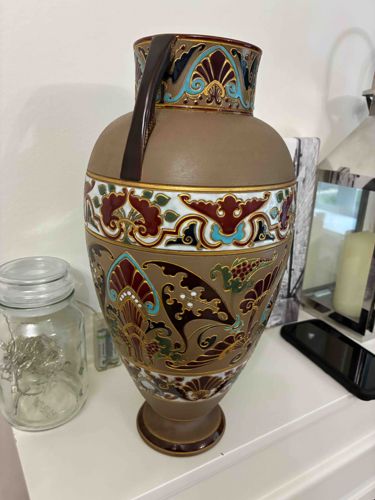
This is a substantial decorative vase, likely ceramic or porcelain, with a matte taupe or light brown body contrasting with richly enameled and gilded decoration. The vase has a classic amphora-like shape, tapering from a broad shoulder to a narrower base with a distinct pedestal foot. A single, dark brown, presumably ceramic or porcelain, handle is attached near the rim, providing a classical or perhaps Art Nouveau accent. The neck features a band of intricate polychrome enameling in tones of deep red, teal, black, and white, accented with shimmering gold outlines and details. This pattern appears to be a stylized floral or foliate motif, possibly referencing Japanese or Middle Eastern design aesthetics common in late 19th to early 20th-century decorative arts. Below this, a narrower white band with similar, but smaller, highly detailed enamel work encircles the mid-section. The main body of the vase is adorned with larger, flowing enameled designs, again featuring a strong presence of gold, various shades of brown, and pops of teal, red, and possibly green. These motifs appear curvilinear and organic, reminiscent of stylized flora or clouds. The craftsmanship appears to be of high quality, evidenced by the precision of the enameling and gilding. No obvious chips, cracks, or significant wear are visible from the provided images, suggesting it is in good to excellent condition. The overall aesthetic points towards a late 19th-century to early 20th-century piece, possibly Meiji period Satsuma ware or European imitation of such, or perhaps a piece influenced by Art Nouveau or Aesthetic Movement designs.
AI Appraisal Report
Upon visual examination of the provided image, this Japanese-Style Enameled Pedestal Vase presents in what appears to be good to excellent condition, with no overt chips, cracks, or significant losses evident. The precision of the enameling and gilding suggests high-quality craftsmanship. Authenticity, based solely on imagery, points towards a late 19th to early 20th-century piece, likely influenced by Meiji period Satsuma ware or a European interpretation of the aesthetic. The single handle and overall form also hint at Art Nouveau influences. The material appears to be high-quality ceramic or porcelain. Market conditions for decorative arts of this period, particularly those with a strong Aesthetic Movement or Japonisme appeal, remain steady. Comparables would include high-quality Satsuma-style vases or continental European pieces that adopted similar design motifs. Demand for such pieces is moderate, driven by collectors interested in late 19th/early 20th-century decorative arts, particularly those with Asian influences. Rarity is moderate; while unique forms and exceptional quality can command higher prices, similar aesthetic pieces do appear on the market. Key factors impacting value include the precise origin (e.g., actual Satsuma ware vs. European imitation), the exact dating, and the reputation of the maker if marked. Limitations in authenticity verification from images alone are significant; I cannot definitively confirm its origin (Japanese vs. European), the exact period, or the presence of any concealed repairs or manufacturing flaws. A full authentication would require in-person examination to assess material composition, inspect for repairs, identify any hidden marks, and determine specific manufacturing techniques. Provenance documentation, if available, would also be crucial, as would scientific testing of materials and enamels.