These notes were written by the person who submitted this item. Appraiser.AI has not verified them, and the AI's identification and estimate may rely on them.
AI Estimated Value
Not an official valuation
$75 - $200
AI estimate as of October 1, 2025 · verify with a professional before acting
AI-Generated · Verify before acting
Everything on this page is generated by AI for informational purposes only. AI can make mistakes — the AI may misidentify items or misattribute them (artist, maker, brand, designer, origin, era). This is not an official valuation and should not be used for insurance, sale, tax, estate, legal, or lending purposes — or any decision requiring a certified appraisal. It is not an authoritative claim about any person, brand, or rights holder — do not share or rely on it as a factual statement about a third party. Always consult qualified professionals before making financial decisions.
This analysis also relies on unverified notes provided by the user, which may be incomplete or inaccurate and could affect the result.
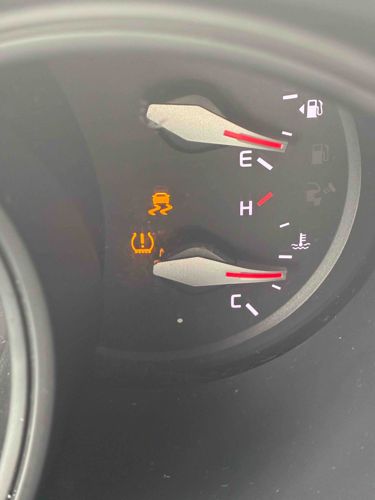
This item is a portion of an automotive instrument cluster display, showcasing several key vehicle indicators. The display is constructed from a dark, likely plastic or composite material dashboard, with white markings and red accents for needles. Visible elements include a fuel gauge on the upper right, indicating a low fuel level with its needle pointing towards 'E' (Empty) and an illuminated fuel pump icon. Below this is a temperature gauge, with its needle positioned towards 'C' (Cold) or normal operating temperature, though 'H' (Hot) is also visible. The needles are silver-toned with bright red tips. Two warning lights are actively illuminated in amber-yellow. The upper warning light depicts a car skidding, commonly known as the Traction Control System (TCS) or Stability Control, indicating it is active or experiencing an issue. The lower illuminated light is a tire cross-section with an exclamation mark, signifying a Tire Pressure Monitoring System (TPMS) warning, indicating low tire pressure in one or more tires. The overall condition appears clean, with no significant scratches, cracks, or fading visible on the display surface, suggesting a relatively modern vehicle. The lighting of the warning icons is crisp and clear, indicative of functional electrical components. The style is contemporary automotive, likely belonging to a vehicle manufactured in the last 10-15 years, prioritizing clear legibility and essential driving information.
AI Appraisal Report
Upon visual examination of the provided image, this automotive instrument cluster display appears to be in very good used condition. The display surface is clean, free from obvious scratches, cracks, or fading, which suggests proper care or relatively low use. The illumination of the warning lights (Traction Control and TPMS) is clear and crisp, indicating functional LEDs and electrical circuits within this section of the cluster. The needles for the fuel and temperature gauges are intact and correctly positioned, suggesting no physical damage to their mechanisms. Authenticity, based on visual cues, appears consistent with genuine automotive components. The style is contemporary, fitting vehicles from approximately the last 10-15 years. This component is a segment of an instrument cluster, not a complete unit. This significantly impacts its value. Complete clusters for modern vehicles can range from $300 to $1000+ new or remanufactured, but a partial display that only includes gauges and warning lights will have a much lower market value, primarily serving as a replacement part for a damaged section of an existing cluster. Demand for such specific partial components is limited; typically, the entire cluster needs replacement if there's a functional issue. Rarity is low as these are mass-produced parts. The active warning lights (Traction Control and TPMS) could indicate either a system fault within the vehicle or simply that the systems are disengaged/need attention, which doesn't directly affect the value of the display itself, but rather the vehicle it's installed in. Factors significantly impacting value include its partial nature and the specific make/model compatibility, which is undeterminable from the image alone. Without knowing the exact vehicle it originated from, assessing precise market demand is difficult. My principal limitation in authenticity verification from an image alone is the inability to inspect internal components, wiring, or manufacturer markings, and to test its full functionality. An in-person examination would allow for inspection of all connectors, part numbers (critical for compatibility and authenticity), and physical testing of the display's response and full illumination range. Provenance documentation (vehicle VIN, service records) would further confirm its origin and authenticity.