AI estimate as of June 23, 2025 · verify with a professional before acting
AI-Generated · Verify before acting
Everything on this page is generated by AI for informational purposes only. AI can make mistakes — the AI may misidentify items or misattribute them (artist, maker, brand, designer, origin, era). This is not an official valuation and should not be used for insurance, sale, tax, estate, legal, or lending purposes — or any decision requiring a certified appraisal. It is not an authoritative claim about any person, brand, or rights holder — do not share or rely on it as a factual statement about a third party. Always consult qualified professionals before making financial decisions.
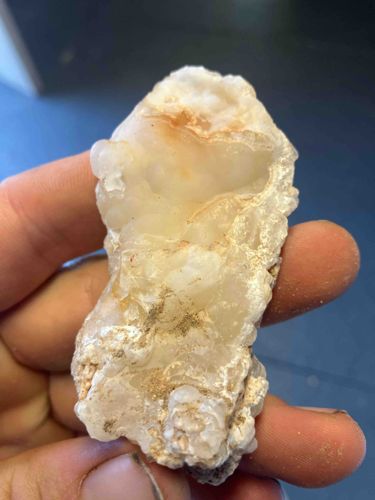
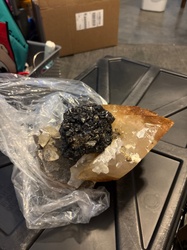
This item is a raw, unpolished specimen of what appears to be common opal or chalcedony, a cryptocrystalline form of silica. It measures approximately 3-4 inches in length and is being held in a human hand, providing a scale reference. The mineral exhibits a predominantly off-white to creamy translucent color, with visible inclusions and veins of a yellowish-brown or light orange hue, suggesting the presence of iron impurities or other mineral staining. The surface is irregular and botryoidal (grape-like) in some areas, indicative of its natural formation within a geode or vug. Portions of the surface show a rough, unweathered appearance with sandy or earthy deposits adhering to it, suggesting it was recently unearthed or not thoroughly cleaned. There are no discernible manufacturing details, maker's marks, or signatures, as it is a natural piece. The overall condition is as excavated, with no obvious signs of recent damage or repair beyond natural fracturing inherent to its formation. While no specific age can be determined without geological context, such mineral formations typically span thousands to millions of years. The quality is typical for a raw, uncommercialized specimen, valued more for its natural aesthetic and geological interest than for any specific craftsmanship, as none is present. Its unique aspect lies in its natural, unadulterated form, showcasing the raw beauty of mineral growth.
AI Appraisal Report
Based on my visual examination of the provided image, this specimen appears to be raw common opal or chalcedony. Its condition is consistent with an uncleaned, recently unearthed natural formation, showing irregular, botryoidal surfaces, and earthy deposits. The colors, off-white to creamy translucent with yellowish-brown/orange inclusions, are typical for chalcedony with iron staining. Authenticity as a natural mineral specimen seems highly probable from the image; there are no indications of artificial manipulation. This is not a refined gem, but a geological specimen. Market conditions for such raw, unpolished common opal or chalcedony specimens are typically modest. Comparables are found in the "collector's rough minerals" or "lapidary rough" categories. Demand is primarily from hobbyist collectors, geology enthusiasts, or those interested in crystal healing, rather than fine art or jewelry markets. Its rarity is low; common opal and chalcedony are abundant globally. The primary value drivers are its pleasing natural form, size (3-4 inches), and the visible mineral inclusions that add character. Its "as excavated" condition, while natural, reduces its appeal for some. Factors significantly impacting value are its lack of precious opal characteristics (play-of-color), its common mineral type, and the absence of any historical or scientific provenance. Without physical inspection, I cannot confirm the exact mineralogical composition (e.g., differentiate common opal from chalcedony definitively) or rule out subtle treatments. A hands-on examination would allow for density testing, scratch tests, and more precise identification. Geological context or provenance documentation would be needed to establish origin and potential scientific significance, while spectroscopic analysis could confirm mineral composition.