These notes were written by the person who submitted this item. Appraiser.AI has not verified them, and the AI's identification and estimate may rely on them.
AI Estimated Value
Not an official valuation
$3,000 - $5,000
AI estimate as of November 4, 2025 · verify with a professional before acting
AI-Generated · Verify before acting
Everything on this page is generated by AI for informational purposes only. AI can make mistakes — the AI may misidentify items or misattribute them (artist, maker, brand, designer, origin, era). This is not an official valuation and should not be used for insurance, sale, tax, estate, legal, or lending purposes — or any decision requiring a certified appraisal. It is not an authoritative claim about any person, brand, or rights holder — do not share or rely on it as a factual statement about a third party. Always consult qualified professionals before making financial decisions.
This analysis also relies on unverified notes provided by the user, which may be incomplete or inaccurate and could affect the result.
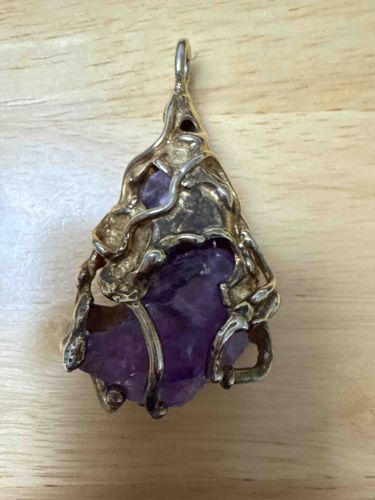
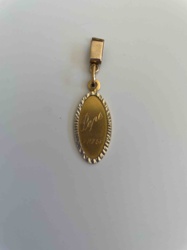
This is a vintage pendant, likely dating from the mid to late 20th century, attributed to the designer Arthur King. The pendant features a prominent, unpolished amethyst nugget, characterized by its deep purple coloration and natural, irregular facets. It appears to be raw or minimally tumble-polished, showcasing the organic beauty of the stone. The amethyst is encased and held within a custom-fitted, sculptural metal setting that wraps around its contours. The metalwork exhibits a distinctive organic, freeform style, reminiscent of brutalist or modernist jewelry designs from the period, a hallmark of Arthur King's aesthetic. The metal, appearing to be gold, possibly yellow gold given its warm tone, has a textured, almost molten or bark-like finish, contrasting with the smooth crystalline surfaces of the amethyst. The setting securely cradles the stone, with various tendrils and projections of metal forming an intricate cage. There is a sturdy bail at the top, consistent with pendants designed to be worn on a chain. Visible condition issues include a soft patina on the metal, which enhances its vintage appeal, and minor wear commensurate with age, such as slight abrasions on the metal surface that do not detract significantly from its overall appearance. No explicit maker's marks are visible in the provided image, but the distinctive design strongly suggests attribution to Arthur King, known for his unique integration of natural stones with sculptural goldwork. The craftsmanship demonstrates a high level of artistry and attention to form, creating a piece that is both rugged and elegant.
AI Appraisal Report
Upon examining the provided image of this vintage amethyst nugget pendant, I observe a piece strongly consistent with the distinctive aesthetic of Arthur King. The use of a substantial, unpolished amethyst nugget encased within a freeform, textured gold setting is a hallmark of his work from the mid to late 20th century. The organic, almost brutalist approach to the metalwork, with its molten or bark-like finish, perfectly complements the natural raw beauty of the amethyst. The deep purple coloration and irregular facets of the stone present well, and its secure, custom-fitted cradle indicates high-quality craftsmanship.
Condition appears very good for its age. The soft patina on the metal is desirable, enhancing its vintage appeal, and minor wear such as slight abrasions is commensurate with age and does not detract from its overall aesthetic. These are expected and contribute to its authenticity as a period piece. The design exhibits a high level of artistry and skill in integrating a natural stone with sculptural goldwork, a characteristic that commands significant appreciation in the market.
Demand for Arthur King's work remains strong among collectors of modernist and artisan jewelry, driven by his unique designs and the scarcity of well-preserved examples. His pieces are recognized for their artistic merit and innovative use of natural forms. Comparable sales of similarly sized Arthur King pendants featuring natural stones in sculptural gold settings typically fall within the $3,000 to $5,000 range, sometimes exceeding this for exceptional pieces or rare stones.
However, it is crucial to note that my assessment of authenticity is based solely on visual attributes in the provided image. While the design is highly indicative of Arthur King, a definitive authentication would require an in-person examination to search for maker's marks, assess metal purity (e.g., 14K or 18K gold often used by King), and analyze construction techniques. Additionally, provenance documentation, such as original sales receipts or exhibition history, would significantly enhance confidence in attribution. Without these, the 'Arthur King attributed' nature of the piece is based purely on stylistic consistency.