AI estimate as of December 1, 2025 · verify with a professional before acting
AI-Generated · Verify before acting
Everything on this page is generated by AI for informational purposes only. AI can make mistakes — the AI may misidentify items or misattribute them (artist, maker, brand, designer, origin, era). This is not an official valuation and should not be used for insurance, sale, tax, estate, legal, or lending purposes — or any decision requiring a certified appraisal. It is not an authoritative claim about any person, brand, or rights holder — do not share or rely on it as a factual statement about a third party. Always consult qualified professionals before making financial decisions.
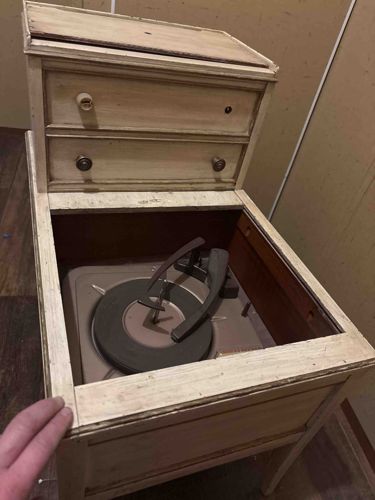
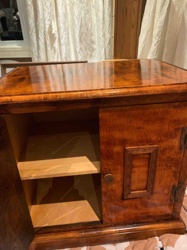
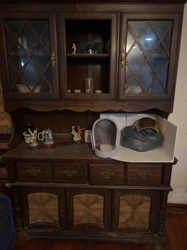
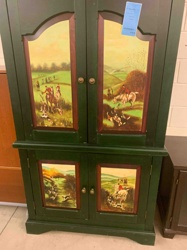
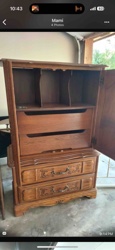
This item is a vintage console record player housed within a wooden cabinet. The cabinet features a distressed off-white or cream-colored paint finish, showing signs of wear and age through scuffs, chips, and darkening of the finish, particularly along edges and raised details, suggesting a shabby chic or aged aesthetic. The top section of the cabinet opens to reveal storage space or possibly a speaker compartment, while below that are two false drawer fronts, each adorned with a single knob. The upper knob on the left appears to be a wooden pull integrated into the drawer front, while the lower knob is a decorative metal piece with a rounded, darker patina. A keyhole is visible to the right of the upper false drawer. The primary compartment for the record player is located at the bottom, accessible by lifting a lid. Inside, a turntable mechanism is clearly visible, designed for playing 45 RPM records, indicated by the small platter and the adapter for larger spindle holes. The turntable components are made of metal and plastic, predominantly in muted tones of gray and black. The interior of the record player compartment has a darker, reddish-brown wood finish, contrasting with the exterior paint. The overall construction appears to be of solid wood or plywood, with simple rectilinear lines. The item exhibits significant signs of age and prior use including grime, paint loss, and possible water stains, contributing to its rustic appearance. The record player unit itself shows some dust and minor surface wear. No distinct maker's marks or signatures are immediately discernible from the image. Its style suggests a mid-20th-century origin, likely 1950s or 1960s, a period when integrated record players in furniture were popular. The craftsmanship, while appearing functional, is characteristic of mass-produced consumer electronics cabinetry from that era.
AI Appraisal Report
I have examined the provided image of this vintage console record player cabinet. The item presents as a mid-20th-century piece, likely from the 1950s or 1960s, characterized by its distressed off-white/cream paint finish and functional design. Its 'shabby chic' aesthetic, a result of significant wear, scuffs, chips, and darkening of the finish, suggests a history of use. The interior reveals a visible turntable mechanism designed for 45 RPM records, which was a common feature of consumer-grade units from that era. The general construction appears to be solid wood or plywood, typical of mass-produced cabinetry.
Authenticity, based on visual cues, points to a genuine vintage item of its type. However, without in-person inspection, I cannot verify the operational status of the record player, which significantly impacts its value. The current market for such integrated record player consoles is somewhat niche. While there's a demand for retro furniture and functional vintage electronics, the significant cosmetic wear, and the apparent focus on 45 RPM play (less versatile than multi-speed turntables) can limit its appeal.
Factors impacting value considerably include the distressed condition, potential non-functionality of the record player, and the absence of any discernible prestigious maker's marks. Comparables for non-functional units in similar condition typically fetch lower prices, often purchased more for their aesthetic as a furniture piece or for restoration projects. Fully functional, well-maintained units from known manufacturers command higher values.
To provide a full authentication and more precise valuation, an in-person examination would be critical to test the record player's functionality, assess internal components for originality and wear, and accurately determine the extent of water damage or structural issues. Provenance documentation, such as original purchase receipts or user manuals, if available, would also aid in historical context and authenticity.