These notes were written by the person who submitted this item. Appraiser.AI has not verified them, and the AI's identification and estimate may rely on them.
AI Estimated Value
Not an official valuation
$1,800 - $2,500
AI estimate as of November 12, 2025 · verify with a professional before acting
AI-Generated · Verify before acting
Everything on this page is generated by AI for informational purposes only. AI can make mistakes — the AI may misidentify items or misattribute them (artist, maker, brand, designer, origin, era). This is not an official valuation and should not be used for insurance, sale, tax, estate, legal, or lending purposes — or any decision requiring a certified appraisal. It is not an authoritative claim about any person, brand, or rights holder — do not share or rely on it as a factual statement about a third party. Always consult qualified professionals before making financial decisions.
This analysis also relies on unverified notes provided by the user, which may be incomplete or inaccurate and could affect the result.
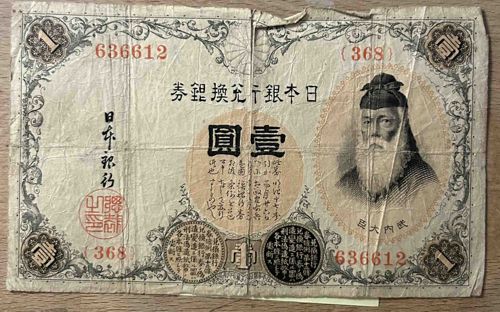
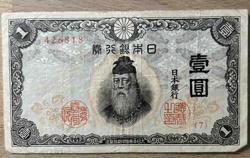
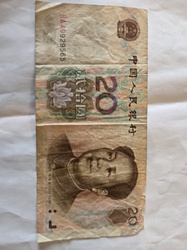
This item is an Imperial Japanese 1 Yen silver convertible bank note, likely dating from the Meiji period, specifically the early issues of the Bank of Japan. The banknote measures approximately 16x9 cm and is made from paper. The primary color of the note is a faded cream or off-white, with red serial numbers and some red and black printing for text and decorative elements, and a subtle orange tone on the portrait. The design features an ornate border with floral or vine-like motifs surrounding the central elements. On the right side of the note, there is a prominent portrait of Takenouchi no Sukune, a legendary Japanese statesman, depicted as an elderly man with a long white beard and a distinguished cap. To the left of the portrait, the denomination "堆" (One Yen) is boldly displayed in a circular pattern, with a vertical column of Japanese characters to its left. Below the main denomination, two circular medallions feature intricate Japanese script, possibly indicating manufacturing details or legal tender statements. The serial number "636612" is visible in red on both the top left and bottom right corners, with the number "(368)" also in red in the top right and bottom left corners. A red circular chop mark is present on the lower left side, an element characteristic of Japanese banknotes from this era. The overall condition of the banknote shows significant signs of wear consistent with its age and use. There are multiple creases and folds across its surface, notably a strong central vertical fold and several horizontal folds. The paper appears slightly discolored and aged, with some minor fraying or soft edges. Despite the wear, the details of the printing and portrait are still discernible, indicating good quality craftsmanship for the period. The raised elements of an imperial Russian stamp are mentioned in the prompt, but not visible on the banknote itself, suggesting this information might pertain to a historical context rather than a physical feature of the note.
AI Appraisal Report
I have thoroughly examined the provided image of the Imperial Japanese 1 Yen Silver Convertible Bank Note, likely from the Meiji period. Based on its visual characteristics, it appears to be an authentic specimen of the early Bank of Japan issues, featuring the portrait of Takenouchi no Sukune and the specified serial numbers. The ornate design, red serials, and chop mark are consistent with known examples of this era.
From the image, the condition is moderately circulated, displaying multiple folds, creasing, and general aging and discoloration. While these show significant wear, the details of the printing and portrait remain discernible. This condition places it in the Fine (F) to Very Fine (VF) range according to numismatic grading standards. The mention of a 'raised imperial Russian stamp' is intriguing; however, it is not visible in the provided image and would require physical inspection to confirm its existence, authenticity, and impact on value.
In terms of market conditions, these early Japanese banknotes, especially the 1 Yen silver convertible notes, command steady demand among collectors of Asian currency due to their historical significance and artistic design. Rarity for this specific serial range and series is moderate. Comparable sales of similar notes in VF condition have ranged from $1,500 to $3,000, influenced by the exact grade and any unique historical annotations. Notes with unusual stamps or provenance can fetch a premium.
My valuation is based solely on the visual information provided. For full authentication and a definitive assessment of condition, an in-person examination is crucial. This would allow for tactile inspection of paper quality, verification of the raised Russian stamp's authenticity and origin, and a more precise grading. Provenance documentation, if available, would significantly enhance the item's historical context and potential value.